Episode Transcript
[00:00:00] Speaker A: Zero.
Not because he couldn't handle himself, because he never needed to. This is Red Dot Mindset. Train the mind, win the fight.
Our guest today is George Sichler, a retired NYPD detective, active firefighter, EMT, hazmat technician, and director of product development at MIRA Safety.
Today we're unpacking a skill most civilians never train. Avoidance. Here's George on what that actually looks like on the ground.
[00:00:28] Speaker B: When you say avoidance is the first line of defense, what does that mean in practical terms for a civilian?
Avoidance means making decisions early enough that you never need the skills people usually think of as self defense.
Most violent encounters don't begin with an attack. They begin with a series of opportunities to recognize something isn't right. The wrong parking spot, the person lingering where they shouldn't be, the argument that's escalating, the shortcut that doesn't feel right. Every decision before the event either increases or decreases your risk.
One of the stories I often say is people are often surprised when I ask them this.
How many times do you think I drew my firearm while I was off duty during my entire career? Now I'll tell you, I've been there, done that, got the T-shirt while I was on duty. Okay, very, very often that would happen. People are often surprised to hear the answer is zero.
Off duty, zero.
Not because I wasn't capable of defending myself, but because avoidance is almost always the best and safest option. I recognized problems early, created distance, changed my plans when I needed to, and simply wasn't there when things bad happened. That's not luck, it's a skill. Preparedness isn't about learning how to fight. It's about learning how to recognize when it's time to leave. The goal isn't to win the fight. The goal is to never have the fight.
[00:02:04] Speaker A: That's the philosophy behind the Grey Matter Ops Avoidance Ladder.
Each rung creates an opportunity to recognize the problem, disengage, and leave before physical self defense becomes necessary.
Avoidance is often confused with fear, but in high-risk professions, it's treated as pure discipline. We asked George why.
George's answer here is worth sitting with. He points out that professionals, police clearing a building, firefighters entering a structure, special operations teams planning a mission, spend enormous time trying to avoid unnecessary risk.
Avoidance isn't fear, it's discipline. He compares it to defensive driving.
You're not afraid every time you get behind the wheel. You've just trained yourself to spot hazards earlier than someone who isn't paying attention.
That's the same distinction we draw in our own approach to preparedness: prepared, not paranoid. Alert, not alarmed. George brings 25 years of public safety experience to that principle, giving it real operational weight.
When a situation turns south, the warning signs are almost always there before the first move is made. We asked George which ones people consistently miss.
[00:03:14] Speaker B: One is people who don't fit the environment. Someone who's standing outside of business without any obvious purpose. Someone paying more attention to people than whatever they're supposedly doing.
Someone who seems overly interested or uninterested in who's coming and going. This is situational awareness 101. Another is changes in normal behavior. Crowds suddenly seeking or looking in one direction. Employees becoming visibly uncomfortable. People quietly leaving an area. Humans are very, very good at sensing problems collectively. We often just ignore these cues.
The third is being forced to make decisions faster than you're comfortable with. Criminals can create urgency. They want you distracted, rushed, embarrassed, or emotionally engaged before you have time to think. They're master manipulators. They're controlling your outcome. If someone is trying to control your pace, that's often your first clue to slow it down.
[00:04:15] Speaker A: Those three signals sit at the recognition stage of the Avoidance Ladder. Baseline, anomaly, decision.
That third signal, manufactured urgency, is exactly the kind of manipulation tactic our own doctrine flags.
When someone pressures you to move faster, that's your signal to slow down.
So what should someone actually notice when they walk into a place, parking lot, hotel, or public space?
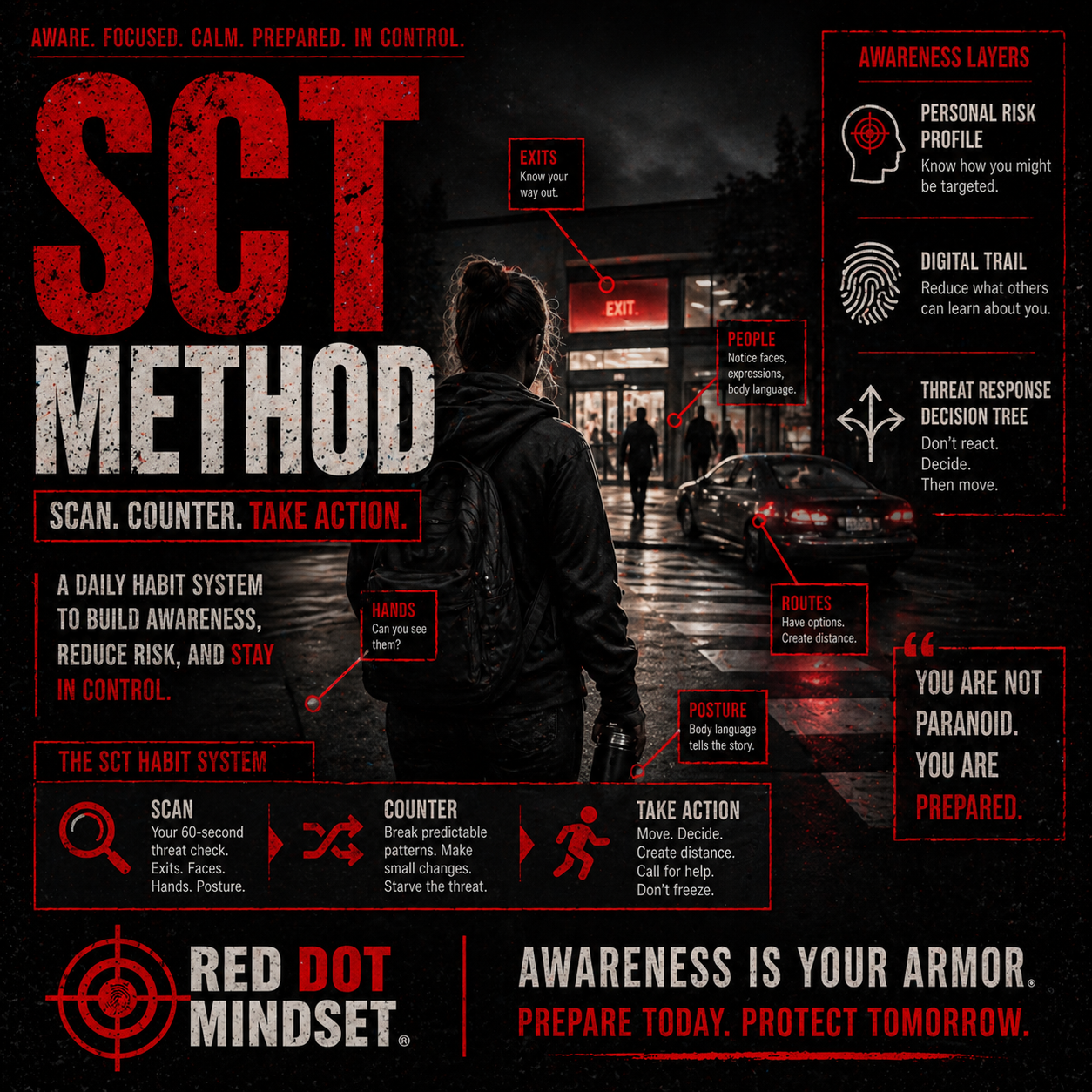
He keeps this simple on purpose. As you enter a new environment, look up instead of down. Notice the lighting. Notice the exits. Notice who's around you. Then ask one question.
Does anything here seem out of place?
He's clear.
You're not hunting for threats everywhere. You're establishing a baseline of normal. So anything that breaks that baseline gets a second look.
Notice what George just walked through without naming it. Lighting and exits. That's the Environmental Geometry Framework in practice. Light discipline and escape vectors help you understand how illumination and exit points shape your options before you need them.
Next, we ask George how civilians should think about creating distance before a situation escalates.
George's framing: distance is time. Time creates options. Options create safety.
He points out that most people give up that advantage voluntarily because they don't want to seem rude. Crossing a street, changing a checkout line, stepping back, leaving an elevator. His line is direct. You don't owe anyone your personal space.
Creating distance usually costs you very little. Standing your ground unnecessarily can cost you far more. We've all had that gut feeling that something isn't right, even when we can't explain why. George's perspective starts with one core idea.
You already know what normal looks like. You shop at the same grocery store every week. You stop at the same gas station. You work out at the same gym. You know what those places normally look like, even if you've never consciously thought about it. Your brain is constantly building a baseline. So when something doesn't fit, you often notice it before you can explain it. What happens next is where people often get into trouble. Normalcy bias, the urge to explain the warning sign away.
George warns that we often start explaining away what we just noticed, and sometimes that's exactly how people miss the warning signs right before they become victims. His personal rule: never talk yourself out of leaving.
If you're wrong, you've lost a minute. If you're right, you may have prevented the emergency altogether.
Never talk yourself out of leaving. In our own doctrine, we call that the Pre-Commit Rule. If the baseline breaks, you leave. No debate. Keep it simple in the moment. A line as easy as "not for me, I'm heading out" is enough. You don't owe anyone an explanation for leaving.
Long before an approach is made, a predator may already be assessing potential targets. George explained that process through a story.
[00:07:17] Speaker B: Absolutely, yes. So in the 1970s, the NYPD had a technique and a tactic that was called Muggable Mary. And Muggable Mary was an undercover female detective, and she was kind of small in stature, and they would send her out into high crime neighborhoods.
She would be wearing maybe disheveled clothing, but usually had a couple of things of value that was kind of out in the open.
And criminals are very good at recognizing a victim.
So she would go out into these high crime neighborhoods by herself. And then there would be a discreet undercover surveillance team that would follow her. So the surveillance team would be watching for people that were watching her. And inevitably, sometimes she would be robbed or mugged, etc. And that undercover surveillance team would come in and affect an arrest.
The city council of New York decided that was too aggressive of a tactic, so that kind of fell out of favor. And then when I got onto the job in the 90s, we still used that concept of Muggable Mary, only he or she didn't know they were playing the game with us. So what that means was we could spot a victim, meaning the police could spot a victim. So we would see somebody that would come out of an apartment building, a restaurant, a subway station. Maybe they were intoxicated, maybe they weren't paying attention, maybe they had their head down, but they didn't know that we were watching them because they looked like a victim to us. They just didn't know they were playing the game.
So we would watch the same way that individual walked down the street, completely unaware of their surroundings. And we would watch for hardened criminals to come in and make that person a victim. And when they would, we would come in and we would affect an arrest. So that was our way of playing Muggable Mary. So here's what it taught me. Criminals can spot a victim the same way police officers can spot a victim.
Victims advertise themselves through their behavior. Head down. Distracted, predictable, isolated, lost in their own world. The good news is you don't have to look tough to avoid looking like a victim.
I make a conscious effort to appear alert, fit, and confident. And that's not an accident. It's a tool. I want a potential criminal to recognize that I'm paying attention, and I'm probably going to be more trouble than I'm worth. Keep your head up.
Put the phone away when you're walking. Make brief natural eye contact when appropriate. Not as a challenge, but simply to communicate, "I see you and you see me."
[00:10:11] Speaker A: The lesson isn't to project toughness. It's to stop advertising inattention. The goal is to look aware. Head up, phone away, brief natural eye contact.
You're reducing one of a predator's greatest advantages: surprise.
If you take one habit away from this episode, make it this one.
[00:10:31] Speaker B: So develop the habit of scanning every new environment as you naturally walk into it. Look ahead instead of down. Notice exits. Notice people.
Ask yourself, does anything seem out of place? You're not looking for danger everywhere. You're simply establishing a baseline of what's normal. You know what normal looks like in your everyday life, so recognize when something doesn't fit that position.
Situational awareness isn't about living in fear. It's about giving yourself a small head start before life forces you to make a bigger, worse decision.
I've spent decades responding after emergencies had already begun. If there's one lesson those years taught me, it's this. The goal isn't to win the fight. The goal is to never have the fight.
[00:11:17] Speaker A: 25 years on the front lines distilled into one operational truth.
The earlier you recognize danger, the more options you preserve.
That's George Sichler, retired NYPD detective and director of product development at MIRA Safety. This episode was produced in partnership with MIRA Safety. If you purchase through our link or use the code REDDOTMINDSET, Red Dot Mindset may earn a commission at no additional cost to you. You can learn more about George and MIRA Safety through the link in our show notes. This has been Red Dot Mindset. Awareness is armor.