Episode Transcript
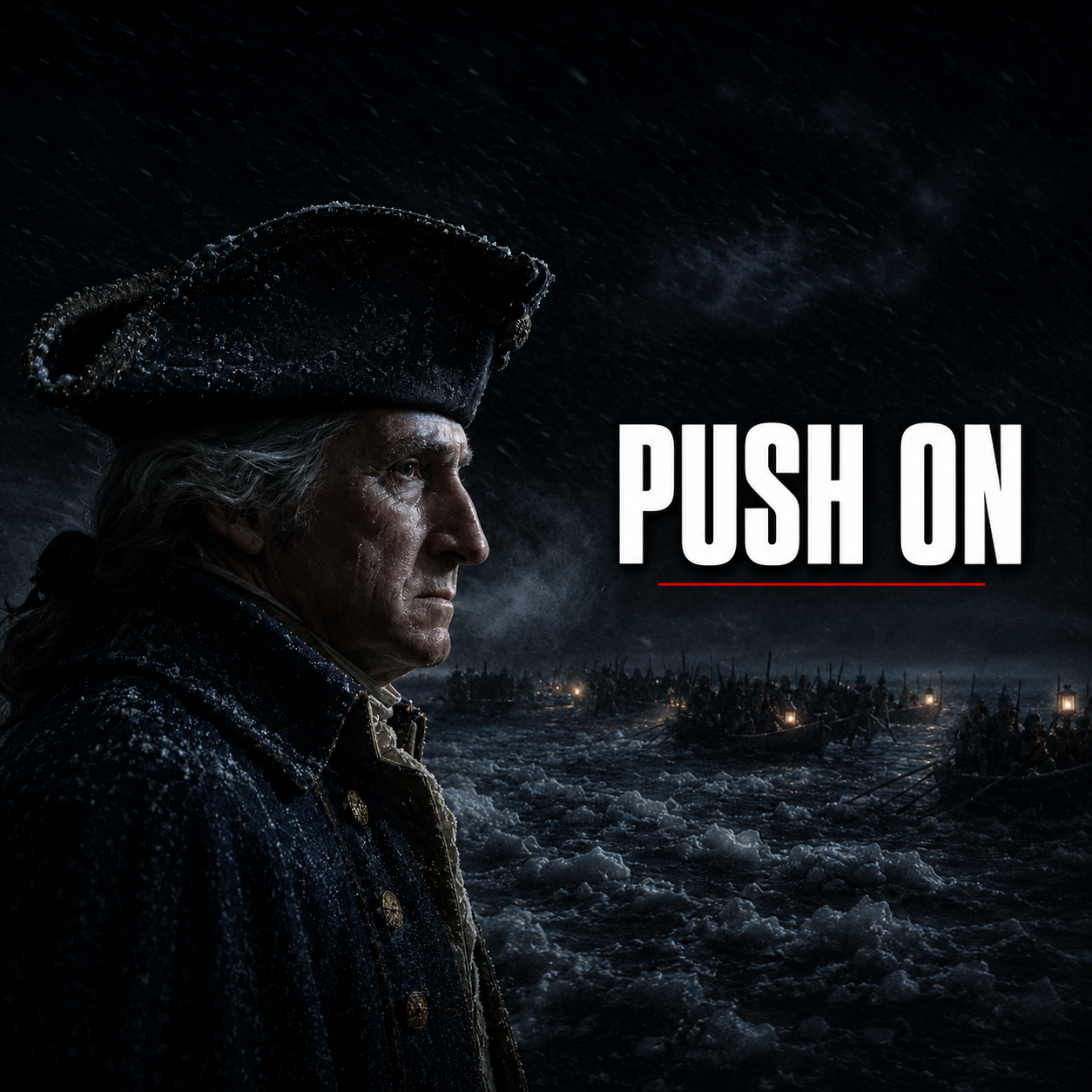
[00:00:00] No music yet, just you. Ice on the oars, not falling snow. Ice, the kind that forms on wood left out in freezing rain that you have to break off with your hands before you can even grip the thing.
[00:00:13] Men who haven't eaten a real meal in two days, standing in line in the dark, waiting to load into boats they can barely see.
[00:00:21] Artillery wheels locking up in the mud at the riverbank, frozen solid. Men throwing their shoulders into wagon wheels that won't turn, cursing under their breath because you can't yell. Not tonight.
[00:00:32] And somewhere out there in the dark, two other crossings are supposed to be happening right now. Different commanders, different landing points. Same night, same storm.
[00:00:42] Nobody on this riverbank knows if either one is gonna make it. This is the night that decided whether there would be a United States.
[00:00:50] Not a metaphor, not a history class exaggeration. If this goes wrong, if the man leading this crossing makes one bad call in the next 12 hours, there may not be a country on the other side of it. Most people know the painting Washington standing tall in the bow of the boat. Flag rippling ice, glowing gold in some kind of impossible sunrise light.
[00:01:14] That's not what this was.
[00:01:17] This was cold, miserable, half blind chaos. Men who had every reason to quit, Being led by a man who had just as much reason to.
[00:01:26] This is that story, not the painting. The night before we get to the river. You need to understand where this army actually was in December of 1776.
[00:01:36] Because if you don't get this part right, the crossing just sounds like a cool stunt. It wasn't a stunt. It was closer to the last move available to a dying organization.
[00:01:46] Washington's army had shrunk to somewhere around the 6 to 7,000 effective men strung out along the Delaware.
[00:01:53] Months earlier, during the New York campaign, he'd had somewhere between 20 and 25,000.
[00:01:59] That's not attrition. That's collapse. And it gets worse. Because most of what was left of that army had enlistments set to expire on December 31st.
[00:02:09] Not if things go badly. Not if morale breaks by the calendar, contractually in days.
[00:02:17] So picture the position Washington was actually in. He doesn't just need a battlefield win. He needs one before the legal clock runs out on the only army he has. Because after December 31, a huge chunk of it is entitled to just walk home, win or lose.
[00:02:32] And this is after a fall that had gone about as badly as a fall can go.
[00:02:37] Long island in August. White Plains in October. Fort Washington in mid November. Nearly 3,000 men captured in a single day. Fort Lee evacuated days Later. So fast they left tents standing with food still cooking.
[00:02:51] Washington himself, writing to his brother in mid December, didn't sugarcoat any of it. His own words.
[00:02:57] If every nerve is not strained to recruit the new army with all possible expedition, I think the game is pretty nearly up.
[00:03:05] No man, I believe, ever had a greater choice of difficulties and less means to extricate himself from them.
[00:03:12] That's not a leader trying to sound confident for the troops.
[00:03:16] That's a private letter to family. That's what it actually looked like from the inside. Here's the red dot frame on this baseline. Because it matters for everything that comes after. This wasn't a leadership pep talk problem. It was a systems collapse problem. An army about to legally cease to exist.
[00:03:36] Sitting on the wrong side of a river from an enemy that had beaten it in every major engagement for four months straight.
[00:03:43] That's the starting position. Not a general looking for glory. A commander looking at the mathematical expiration of his entire operation with one option left abuail that might buy him more time.
[00:03:55] So here's the plan. Washington actually built three columns crossing the Delaware at three different points, converging on Trenton at the same time.
[00:04:03] Washington himself. Roughly 2,400 Continentals plus artillery crossing at McConkey's Ferry several miles upriver from Trenton.
[00:04:13] James Ewing. 7 to 800 Pennsylvania militia crossing directly opposite Trenton with the job of blocking the bridge over Assun Pink creek so the Hessian garrison couldn't escape south once the attack started.
[00:04:26] John Cadwallader. Around 1800 men, a mix of militia and continentals crossing further south near Bristol, tasked with pinning down British reinforcements so they couldn't reinforce Trenton in time.
[00:04:38] Three columns one night, one coordinated hammer blow.
[00:04:43] Here's what you need to sit with. Only one of the three made it across. Ewing's militia couldn't get across at all. Not because of enemy fire. There wasn't any. Yet. Ice and current. The river beat them before they could get moving.
[00:04:57] Cadwalader got some of his men across but couldn't land his artillery. The far bank was too icy to get the guns up, and without artillery support, he made the call to pull his men back rather than commit them alone.
[00:05:09] No enemy contact caused either failure. Pure physics. Pure weather. Pure bad luck stacked on top of an already brutal ask.
[00:05:18] Let that sink in for a second. Because it's the whole hinge of this story.
[00:05:22] Two thirds of Washington's plan died before a single shot was fired, and nobody fired a shot to kill it. Now the boats themselves, briefly, because it matters for how impossible this Actually was Durham. Boats, 40 to 66ft long, most closer to 60. Flat bottomed, built to haul iron ore and grain down the river. Not built for a covert nighttime military crossing in a storm.
[00:05:48] About 20 of them were pressed into this and they weren't hauling the artillery. The 18 cannon and roughly a hundred horses went across separately on flat bottomed ferries with ramps rolled and driven on by hand in the dark. Because a panicked animal on an icy deck is its own kind of disaster.
[00:06:07] Modern reconstructions suggest each gun movement was slow, dangerous and manpower intensive.
[00:06:13] Not a simple roll on, roll off process. 18 guns move that way one at a time in the dark.
[00:06:21] Do that math against single night.
[00:06:24] Here's the red dot frame and I want you to actually hold on to this one.
[00:06:28] Plans don't fail politely and they don't fail all at once. They fail incrementally.
[00:06:34] Ewing fails quietly hours before Washington even knows for certain. Cadwalader fails a little later for a different reason. And Washington on the Pennsylvania shore doesn't get a clean signal that says abort now. He gets silence. He gets uncertainty. He gets a slowly building picture that the operation he planned no longer exists while he's still mid crossing in the dark with no way to call it off even if he wanted to.
[00:07:03] That's the part people miss when they look back at history with the ending already known in the moment. There is no alarm bell. There's just the plan quietly not being the plan anymore. One failure at a time.
[00:07:14] This is the center of the whole story.
[00:07:17] This is the moment.
[00:07:18] The original plan called for the attack to happen before dawn. Hit Trenton while it's still dark, while the element of surprise is at its strongest.
[00:07:28] That was the design.
[00:07:30] Here's what actually happened. Washington's column didn't finish crossing men, horses and all 18 guns until roughly 3 in the morning.
[00:07:39] That's already hours behind.
[00:07:42] Then there's a 9 to 10 mile march still ahead of them in the dark on roads turning to ice through a storm that hadn't let up.
[00:07:50] By the time they're within striking distance of Trenton, it's daylight. The attack doesn't actually start until around 8 in the morning.
[00:07:58] Three plus hours behind the original schedule and with the sun already up.
[00:08:02] Here's why that daylight mattered so much more than a scheduling for problem.
[00:08:07] In 18th century linear warfare, an attacking force caught approaching on open roads in daylight without its flanking support in place was in serious danger.
[00:08:18] A fortified or alert garrison could see them coming and cut them apart before they ever close. The distance darkness wasn't Atmosphere. It was cover and it was gone.
[00:08:29] Two of the advantages the plan was built around.
[00:08:33] Darkness and timing were gone for good.
[00:08:36] Surprise was no longer guaranteed.
[00:08:39] Washington had to gamble that the storm, the enemy's own assumptions and the speed of his final approach would preserve enough of it to matter.
[00:08:48] And here's what Washington knows at this point. Standing on the New Jersey side in the freezing dark, his own column made it. That's it. He has no reliable confirmation that Ewing crossed. No reliable confirmation that Cadwalader crossed. He is operating on the assumption and that he might be the only piece of a three piece plan that actually exists.
[00:09:08] And he's already committed. Already across the river with no clean way back.
[00:09:12] I want to be straight with you about something here because a lot of retellings of this moment get sloppy and I'm not going to do that to you.
[00:09:19] There's no surviving letter where Washington sits down and writes, I nearly called the whole thing off that specific beat. Some sources will tell you as flat fact isn't in his own hand.
[00:09:32] What we do have is his own explanation written afterward of the reasoning that got him through that moment. His words. As I was certain there was no making a retreat without being discovered and harassed on repassing the river, I determined to push on. At all events.
[00:09:49] Read that again. That's not bravado. That's a commander doing cold math. Going back is now more dangerous than going forward.
[00:09:57] Retreat means recrossing an icy river in daylight, potentially under fire, with an exhausted army, forward at least still has a chance.
[00:10:05] Here's the red dot frame and this is the one I want you to actually carry out of this episode. There's a difference between plan A adherence and real discipline. Plan A, adherence is white knuckling. The original plan, because that's what you rehearsed even after the conditions that plan depended on no longer exist.
[00:10:24] Real discipline is recognizing plan A is dead, clearly without denial and making a controlled, deliberate call anyway. Not freezing, not panicking, not scrapping the mission out of fear or fatigue. A cold, clear eyed decision made with degraded information because waiting for perfect information was never gonna be an option.
[00:10:46] Washington didn't get the plan he trained for.
[00:10:49] He got a river, a storm, two thirds of his support gone and a clock running out on his own army's existence. And he made a decision anyway.
[00:10:59] That's plan C, not the backup plan I had ready. The plan you build in real time, standing in the wreckage of plan A and plan B because the mission still has to happen.
[00:11:11] A good pivot only matters if what comes after it holds together.
[00:11:16] So let's move fast through the execution because the discipline in this part is what actually earns the decision. Washington just made the March to Trenton, 9 to 10 miles in the dark, in a storm that hadn't broken.
[00:11:30] Men without proper boots left blood in the snow along the route. That detail is well documented for this specific march, not a detail borrowed from somewhere else in the war.
[00:11:41] Two men collapsed from exposure and died along the way, not in combat. From the march itself at Trenton, the plan split into two columns. Nathaniel Greene's column coming in from the north, John Sullivan's along the river road from the west and south, converging on the town at close to the same time with Henry Knox's artillery positioned to sweep the main streets and cut off any organized retreat. Retreat.
[00:12:07] Now the Hessian garrison.
[00:12:10] I want to correct something here because there's a version of this story that gets repeated a lot and it's not accurate. The idea that the Hessians were drunk or asleep after a Christmas celebration, that doesn't hold up. These were experienced troops. They'd fought at White Plains, at Fort Washington, roughly 1400 men under Colonel Johann Rall, a commander with real combat experience, not some green garrison caught napping.
[00:12:35] What actually happened is more useful to us anyway because it's not luck. It's a failure pattern.
[00:12:42] Rawl had warning indicators coming from multiple channels. Spy reporting deserters and local loyalist information all pointed the same direction.
[00:12:52] The problem wasn't that no signal existed. The problem was that the signal didn't fit his assumptions. So he dismissed it.
[00:12:59] Not because he was drunk, because he was overconfident. He didn't believe Washington's broken, freezing, half starved army was capable of mounting a real attack in this weather. So the warnings he had didn't change what he did.
[00:13:12] That's not incompetence. That's multiple pre incident indicators. Sitting right in front of a trained officer and getting waved off because none of them matched his picture of what his enemy was capable of. The result, complete tactical surprise. And here's a detail worth sitting with. The same storm that nearly wrecked Washington's crossing is part of what made this work. Once the shooting started, sleet and driving snow soaked gunpowder and foul flintlocks. A lot of the muskets on both sides that morning simply wouldn't fire.
[00:13:45] Henry Knox's artillery crews, who could keep their touch holes covered and dry between shots and stayed functional when infantry muskets were failing all around them.
[00:13:54] The battle was won partly because the Americans brought heavy working firepower. Into a town where the enemy's small arms were going quiet in the storm.
[00:14:03] The attack opened around 8 that morning.
[00:14:06] Depending on which account you read, it was over in anywhere from under an hour to just under 2. Either way, fast. Hessian losses roughly 22 killed, somewhere in the range of 80 to 90 wounded and roughly 8 to 900 captured depending on the count.
[00:14:24] American losses? A handful wounded in the actual fighting, including an 18 year old officer named James Monroe shot through the shoulder and at least two men who died from exposure associated with the march in operation, not the fighting itself.
[00:14:39] A good pivot only matters if the follow through holds.
[00:14:42] Washington's did all the way through.
[00:14:44] So what do you actually do with this?
[00:14:47] Here's the framework laid out clean. Plan A is the plan you build and rehearse. Plan B is the backup you have ready before things go wrong. Plan C is the plan you build in real time after both of those have already failed, using only the information and resources you actually have left in that moment, not the ones you wish you had.
[00:15:06] Most people never train for plan C. They train for A. Maybe B, if they're disciplined. Almost nobody trains their mind for the moment when both of those are gone and they still have to make a call.
[00:15:19] Think about what that actually looks like in your life. Comms go down in the middle of an emergency and you can't reach the people you were counting on.
[00:15:29] Your primary evacuation route is blocked and you're standing at the fork with seconds to decide.
[00:15:35] A business loses power during the exact event it needed power for.
[00:15:39] A caregiving plan, the one you built carefully with backups, falls apart. The one day your backup person is unreachable and you're the only one left holding it. None of those moments come with a clean signal telling you the plan is officially dead. They come the way Washington's night came. Quietly, incrementally. One failure stacked on another while you're already committed and moving.
[00:16:04] Here's the field version of plan C. Discipline broken into three parts you can actually run when it's your turn.
[00:16:11] Recognize. Admit clearly without denial that the original plan is no longer real.
[00:16:17] Not it's a little off schedule. Gone.
[00:16:21] Recalculate. Take honest stock of what's actually left.
[00:16:25] Resources, people, time. Roots.
[00:16:28] Not what you wish you had. What you have commit. Make the next controlled move without waiting for perfect information. Because perfect information was never coming.
[00:16:39] That's what Washington did on that riverbank, whether he had a name for it or not.
[00:16:43] The takeaway isn't have a better plan B. Everybody already knows that one. The takeaway is build enough mental flexibility that you can still make decisions after the plan breaks. Not perfect decisions, not decisions with full information, controlled ones. Decisions you can stand behind made with a clear head in the wreckage of the plan you actually wanted to run.
[00:17:08] That's the mindset that got a freezing, half starved army across an ice choked river and into a fight it had no business winning. Not a perfect operation.
[00:17:18] A commander who could still function, still decide, still lead, after everything around him had already gone wrong.
[00:17:26] Four days after Trenton, the Continental Congress's Committee of Secret Correspondence wrote to their commissioners in Europe. The men working to secure French support for a revolution that up to that point had looked like it was losing. Here's what they we hope this blow will be followed by others that may leave the enemy not so much to boast of as they some days ago expected and we had reason to apprehend.
[00:17:53] Read between those careful formal words and you can hear the relief underneath them.
[00:17:58] This wasn't written by people who thought victory was inevitable. It was written by people who four days earlier had genuine reason to believe the whole thing might be over.
[00:18:07] 250 years later, we get to look back and call this the turning point. Nobody on that riverbank on Christmas night knew that's what it was. They just knew the plan had broken, the clock was running out and somebody had to decide what came next.
[00:18:20] This country doesn't exist because a plan worked perfectly. It exists because it didn't. And because the men holding it together found a way to keep making decisions anyway.
[00:18:30] Train the mind, win the fight.
[00:18:32] Stay gray, stay ready.