Episode Transcript
[00:00] Speaker A: Okay, let's just jump right in. Everyone listening right now, you're probably dealing with something intense. Maybe it's chaos at work, maybe trying to juggle career and family, or perhaps it's a really tough personal health situation. These are — well, there are battlefields, right? We hear all the time, the mind is our best weapon. But what if, what if that powerful mind is actually what trips us up, the thing causing the panic?
[00:23] Speaker B: That's absolutely the core paradox. Our minds are wired for survival, which often means defaulting to fear, to paralysis, even avoidance — as soon as things get genuinely hard, what Brent Gleeson often calls "the suck." And Grey Matter Ops adapts these ideas, these high-performance principles, specifically for civilian readiness.
[00:42] Speaker A: Right. And that's exactly what we're diving deep into today. We want to get past just talking about resilience. Our mission here is to pull out practical, structured, really tactical tools. We're taking principles from the absolute toughest environments and making them usable — a blueprint for you, for your own mission, no matter the chaos.
[00:59] Speaker B: Yeah, the goal is to show you how to take that internal struggle, that feeling of being totally overwhelmed, and actually use it. Not something that stops you, but as fuel — like high-octane fuel for real growth and getting things done.
[01:12] Speaker A: Okay, let's unpack that core idea first, because it really changes everything about how we face difficulty. The source material is very clear: resilience isn't some fixed thing you're born with.
[01:23] Speaker B: Exactly. It's much more like a muscle. You have to train it. It takes deliberate focus, real determination to make it stronger. If you hit a setback and think, "Oh, I'm just not resilient," you're already setting yourself up with a fixed mindset. You've basically guaranteed failure before you even start.
[01:39] Speaker A: So we need to treat it like any other skill we develop. How do we actually break that skill down?
[01:44] Speaker B: The source is talking about three key pillars — the Three C's. They sort of define how a resilient person responds when things go sideways. First up is challenge. This is about instantly reframing difficulty, failure, mistakes — instead of seeing them as a dead end, a wall you just crash into, you see it as data, as a lesson, an opportunity to immediately learn something and grow. So shifting that internal voice from "See, I knew I couldn't do it" to something like "Okay, what's the one key thing this failure just taught me?"
[02:16] Speaker A: Precisely, and that links directly to the second C — commitment. Resilient people have a defined purpose. A why. That purpose drives them, keeps them focused on the bigger goals, stops them from getting easily sidetracked by — well, by the suck, by the discomfort. When motivation dips, that commitment rooted in purpose keeps them going.
[02:38] Speaker A: Okay, challenge, commitment, and the third C?
[02:38] Speaker B: Control. This one sounds straightforward, but I bet it's the toughest in practice.
[02:41] Speaker A: It often is. Control is really the lynchpin. Highly resilient folks focus their mental energy — like laser focus — only on things that can actually influence right now. Their immediate sphere. They consciously avoid spinning out on the big-picture stuff they can't change in this moment. Think: worrying about the whole economy versus nailing those two reports due today. That's the difference.
[03:04] Speaker A: Okay, I get the principle, but let me push back a bit. What if it's a real crisis? Job loss, a serious diagnosis — isn't trying to focus small just ignoring the elephant in the room? Isn't that just denial?
[03:16] Speaker B: That's a really fair question. It's not about ignoring the threat. It's about discipline of focus — tactical action over strategic worry. You don't pretend the diagnosis isn't real. You focus relentlessly on the very next step you must take: finding the right specialist, filling out that first piece of paperwork, calling that one contact. Those small, controlled actions give you a sense of agency. They stop the emotional overwhelm.
[03:39] Speaker A: That makes sense. It prevents the total shutdown. And that idea of constant, committed action — it ties into the internal drivers, doesn't it? Beyond the Three C's, Gleeson talks about the Three P's for high achievement.
[03:49] Speaker B: Yes, the Three P's: persistence, purpose, and passion. Purpose gives you the why. Passion gives that initial spark. But persistence? That's the powerhouse. You know that Coolidge quote — "Nothing in this world can take the place of persistence. Persistence and determination alone are omnipotent." It's powerful stuff.
[04:10] Speaker A: Wow, that really cuts through the mystique of genius or talent, doesn't it? It basically says gifted or not, the person who just keeps grinding, keeps showing up — especially when it's hard — they win.
[04:20] Speaker B: That's exactly it. Success isn't always flashy. Often it's just the outcome of relentless, consistent effort. Day in, day out. And that persistent effort — that's where the mindset piece is crucial. Carol Dweck's work on the growth mindset: if you genuinely believe abilities can be developed, that you can get better through hard work, then effort is just part of the process. Failure isn't fatal — it's just feedback.
[04:42] Speaker A: But failure feels like more than feedback, right? Psychologically, it hits hard. The sources mention how it actually distorts our perception.
[04:50] Speaker B: It's fascinating, isn't it? Research shows that after failing at something — like missing a target or bombing a presentation — people literally judge the goal as being physically farther away or harder to achieve next time. Failure shrinks our view of our own capabilities. It makes the challenge look bigger, more daunting. And that's when people pull back. They retreat into what feels safe, maybe avoid trying big things again, because that sting of failure feels too risky.
[05:17] Speaker A: Okay, so that retreat, that flinch reaction — that's the critical moment. That's where we need a specific tactic to regain control. This is where the Three-Foot World concept comes in, right? Disciplining your focus.
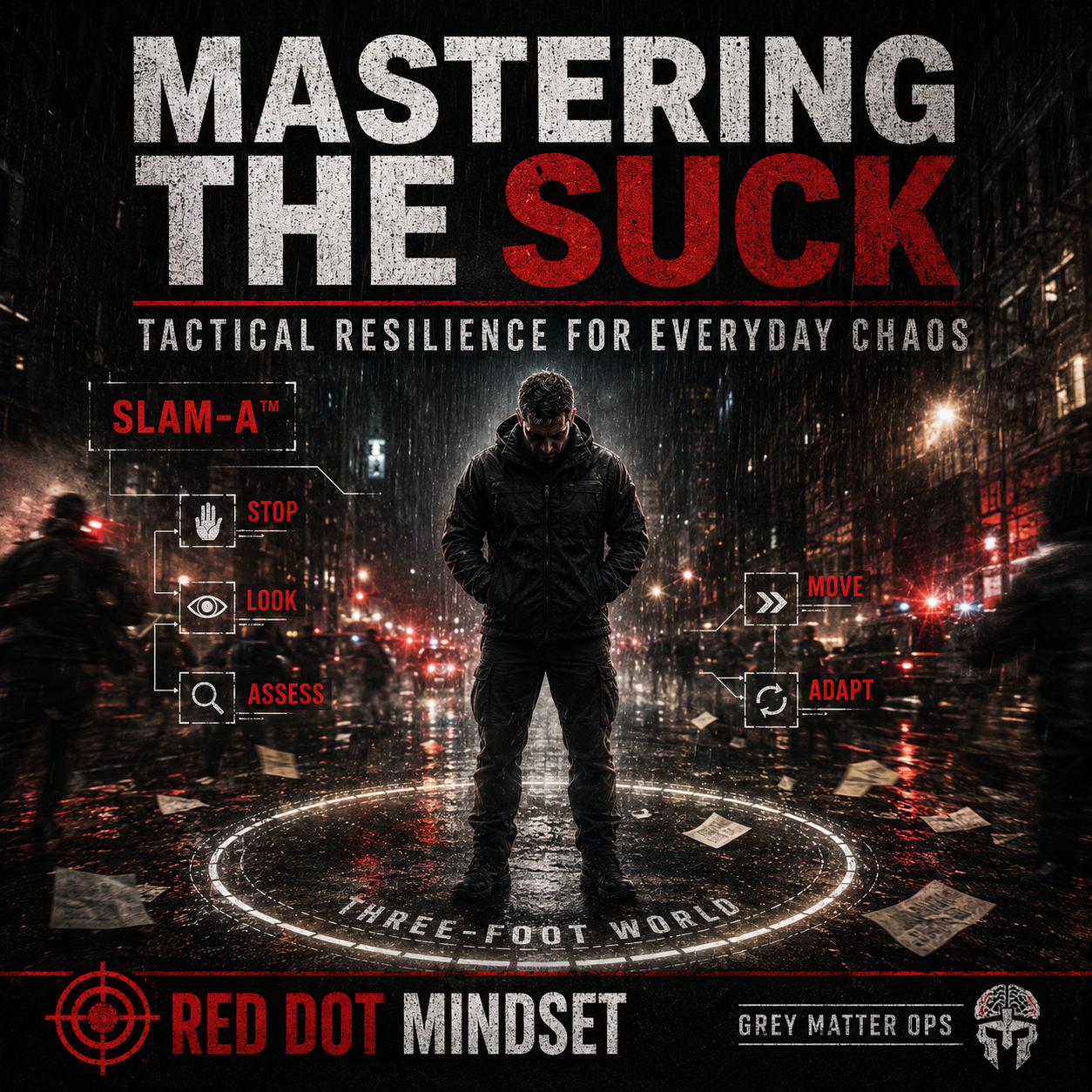
[05:27] Speaker B: Absolutely critical. This is a core tactical idea adapted for everyday life. When chaos erupts — let's say you're managing a big project, deadline looming, and a key supplier just completely flakes. The whole timeline is shot, panic sets in. You have to consciously shrink your focus, right down. Your three-foot world is only what you can immediately influence — right here, right now.
[05:49] Speaker A: So you actively ignore the panic, the emails flooding in, ignore the big-picture disaster for a second, and focus on the very next tiny, controllable thing — like literally opening the contingency plan doc, sending one calm text, taking one deliberate breath.
[06:03] Speaker B: Precisely that. You're short-circuiting the panic loop. By shrinking your world temporarily, you regain control. You stop the uncertainty from completely hijacking your system. It's the Sentinel Mindset from Grey Matter Ops, applied to your desk, your kitchen, your life. Hyper-aware, but disciplined in your response.
[06:21] Speaker A: And doing that — taking that disciplined action — often means leaning into the discomfort, the immediate pain, which brings us to something counterintuitive: pain itself can actually be a pathway to growth.
[06:31] Speaker B: It sounds strange, but yes. Psychologists studying people who've been through major trauma or hardship often find something remarkable. Nobody liked the suffering, obviously — but a huge majority report significant personal growth afterwards. They gain perspective, a clearer sense of what matters, deeper resilience. They feel stronger, wiser.
[06:51] Speaker A: So it's not just about surviving. It's the processing after the event — the reflection, the recalibration.
[06:55] Speaker B: Exactly. The discomfort itself — the anxiety, the stress, the grief — it often acts as a catalyst. There's research, like from Kazimierz Dąbrowski, suggesting that actively avoiding pain or anxiety might actually mean avoiding your own potential for deeper psychological growth. That temporary pain can be the entry fee for profound positive change.
[07:17] Speaker A: Okay, so if suffering, stress, setbacks — if they're just part of life, guaranteed — then the real question becomes: what are you choosing to suffer for? Are you pushing through hardship for goals that genuinely align with your deepest values, your purpose? Or are you just kind of staying comfortable? Just stuck in mediocrity, suffering the quiet pain of regret later on.
[07:34] Speaker B: That choice demands clarity. It demands a compass. It's that classic idea from Stephen Covey — begin with the end in mind. Think about how you want to be remembered, seriously. What do you want people to say? Then look at your actions today, right now. Do they line up? If not, you might be spending your energy, your suffering, on things that ultimately don't matter to you. Burning willpower on the wrong battles.
[07:58] Speaker A: Speaking of willpower — we know from researchers like Roy Baumeister that it's finite, right? Like a muscle, it gets depleted.
[08:06] Speaker B: But crucially, you can also train it, strengthen it.
[08:10] Speaker A: Correct. And interestingly, studies suggest happier people often have higher self-control — not because they're superhuman, but because they're better at achieving the goals they actually care about. They structure their lives, their environments, to minimize the constant drain on willpower from fighting small temptations — you know, like endlessly scrolling social media or putting things off. Training that willpower muscle involves daily diligence, small choices, consistently made.
[08:37] Speaker B: Okay, so we've got the trained mindset, the clear purpose rooted in values, the stronger willpower. Now we need the "what to do when it hits the fan" framework — when the plan breaks. This sounds like where the Grey Matter Ops SLAM-A™ Protocol fits perfectly.
[08:47] Speaker A: Exactly. SLAM-A provides that immediate structured response. It stands for Stop, Look, Assess, Move, Adapt. It's a cognitive sequence designed to override the initial panic reaction when you're faced with adversity or need to execute under pressure.
[09:01] Speaker B: So — Stop: halt that knee-jerk panic, just freeze for a second. Look: observe the situation through that focused lens, your three-foot world — what's actually happening right here? Assess: figure out the immediate threats, yes, but also your available resources. What can you leverage right now? Move: take decisive action based on that assessment, the next logical step. And Adapt — because things change. Continuously adjust based on feedback and the evolving situation.
[09:26] Speaker A: It's the critical difference between just reacting emotionally — maybe flailing around — and responding tactically, deliberately. This process forces you to define your objective very clearly, make it concise, measurable, time-bound. And then crucially, identify what's likely to punch you in the face, as they say — what are the immediate obstacles? This allows for realistic contingency planning. You're not expecting failure, but you're ready to adjust course when needed.
[09:53] Speaker B: And that final piece — the Move and the Adapt part — it circles back to persistence and just getting started. General Patton's quote seems relevant here: "A good plan, violently executed now, is better than a perfect plan next week."
[10:04] Speaker A: Absolutely. Waiting for perfect information, perfect conditions — that's often just procrastination in disguise, a form of fear. The enemy of getting things done is often the pursuit of the perfect plan. Get enough data to make the next move. Then get moving.
[10:19] Speaker B: All right. So we've covered some really foundational ground today. Resilience is a skill you build, not a trait you're born with. When chaos hits, you've got to discipline your focus and shrink it down to your immediate three-foot world. And all your actions — especially the tough ones — need to be guided by clearly defined values and purpose.
[10:39] Speaker A: Yeah, and by aligning those daily actions, that persistent effort, with your core purpose, you make sure that the inevitable suffering — the stress from that big project, the difficulty of a personal crisis — actually means something. It serves your bigger goals. When you really think about it, life is finite. We all face challenges. We all face adversity. The choice isn't if you'll experience hardship, but what you're willing to endure it for. So the question for everyone listening is: are you using your time right now to take those determined, disciplined steps towards a life that matters to you? Or are you kind of just letting things happen, leaving that list of future regrets up to chance?
[11:14] Speaker B: That choice isn't made in some grand moment. It's made right now, in the small acts of discipline. Define your mission. Apply a framework like SLAM-A to your biggest challenge today. And execute. That's how you start transforming adversity into your greatest strength.