Episode Transcript
[00:00] Speaker A: So imagine you're walking to your car in a dark parking garage, right? You hear footsteps echoing behind you. They're heavy, they're deliberate, and moving fast. Your heart just spikes.
[00:11] Speaker B: Oh, yeah. Your stomach drops.
[00:13] Speaker A: Exactly. You've just experienced a jump scare. But according to the intelligence we are looking at today, if you wait for that jump scare to happen, you have already lost.
[00:22] Speaker B: You really have. That is the brutal reality of how most people visualize danger. We start the movie in our heads at the exact moment of physical contact, right?
[00:34] Speaker A: Like safe one second and then suddenly, boom, entirely unsafe the next.
[00:38] Speaker B: Yes, but that binary thinking is a massive vulnerability.
[00:42] Speaker A: Yeah.
[00:42] Speaker B: I mean, it tricks you into believing that violence is a lightning strike, that it's completely random, unpredictable, and impossible to control.
[00:50] Speaker A: Which leaves you moving through the world feeling just entirely powerless. Just hoping the lightning doesn't hit you today.
[00:56] Speaker B: Exactly.
[00:57] Speaker A: So today we are taking a deep dive into this really fascinating training doctrine from a group called Grey Matter Ops.
[01:04] Speaker B: Yeah, they're a Red Dot Mindset framework.
[01:07] Speaker A: Right. For personal safety and situational awareness. And the core mission of this deep dive is to completely rewire how you think about danger.
[01:15] Speaker B: We want to move away from the paranoia, right. Ditch the fear and really unpack a disciplined cognitive process that helps you buy the single most valuable resource you can have in any situation, which is time.
[01:28] Speaker A: Time, absolutely. But let's establish the tone right up front here because this is not some macho fear-mongering boot camp.
[01:36] Speaker A: Yeah, no tactical gear required.
[01:38] Speaker B: Right? Exactly. And we are certainly not suggesting you live your life constantly looking over your shoulder. The doctrine we're looking at is an incredibly calm, informed, and practical guide for everyday civilians.
[01:50] Speaker A: The goal is to be prepared, not paranoid.
[01:53] Speaker B: Alert, not alarmed.
[01:54] Speaker A: I love that. Prepared, not paranoid. So to buy that time, we first have to unlearn, I think, the biggest lie Hollywood has ever sold us.
[02:01] Speaker B: Oh, the out-of-nowhere myth.
[02:02] Speaker A: Yes. This idea that violence comes out of nowhere. The guy jumping out of the alley or the sudden bar brawl.
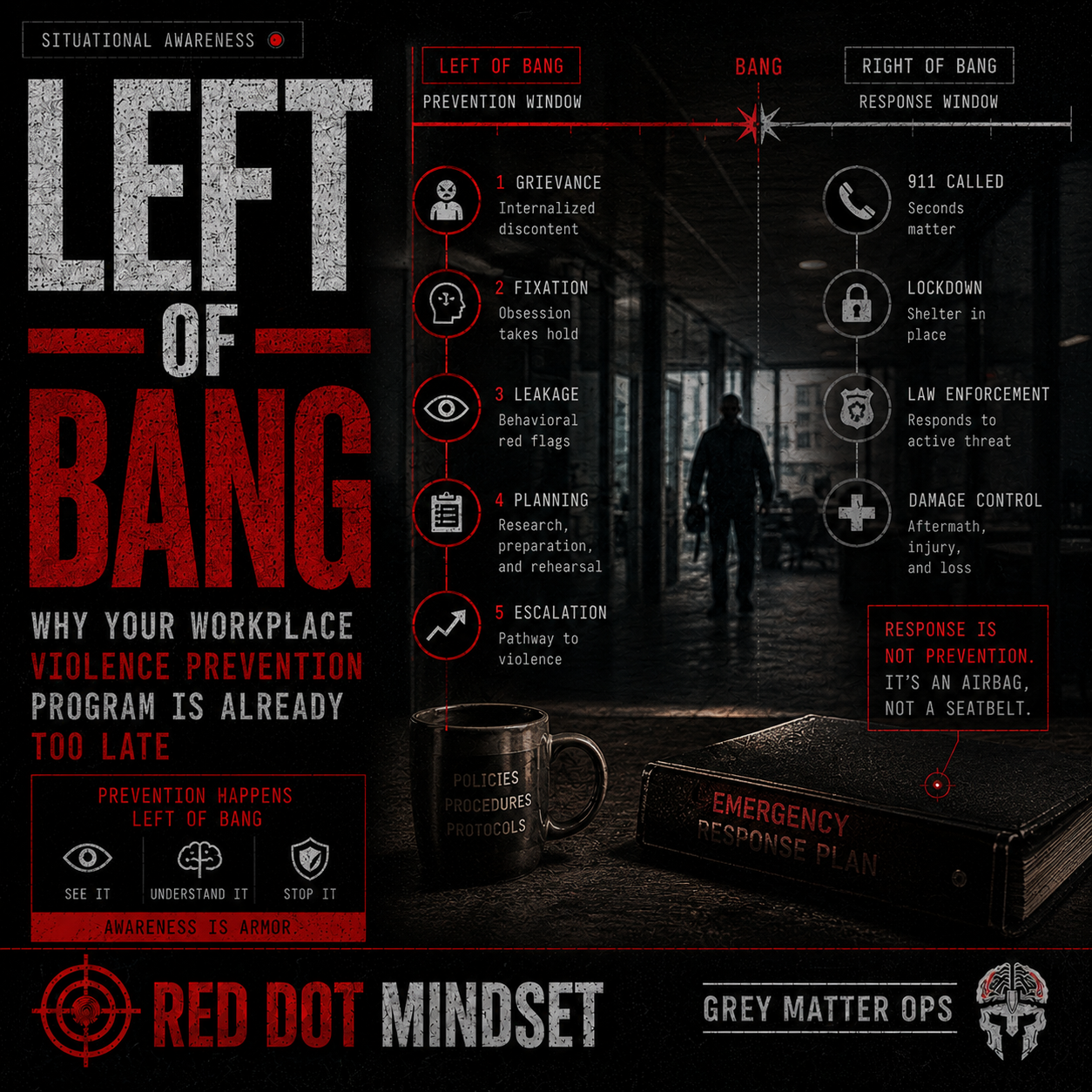
[02:08] Speaker B: It rarely, if ever, comes out of nowhere. What the Grey Matter Ops doctrine emphasizes is that violence builds in distinct stages. It leaks clues — massive clues — long before any overt physical act takes place. A bad actor leaks information through their timing, their positioning, their behavior, and just how they disrupt an environment.
[02:30] Speaker A: Because whether we're talking about a seasoned criminal or a crime of opportunity or just an unstable individual, they all share a common set of requirements.
[02:41] Speaker B: Right. They can't just operate in a vacuum.
[02:43] Speaker A: No. They need the conditions to be right. They need a level of distraction. They need physical access to you. And most crucially, they need a target who is late to recognize what is actually happening.
[02:54] Speaker B: That is their exact formula for success. And to achieve that formula, they have to engineer it. The sources refer to this as the setup phase.
[03:02] Speaker A: The setup phase?
[03:03] Speaker B: Yeah. And the setup phase involves observation, testing boundaries, positioning, and these really subtle attempts to close the physical gap between them and you without triggering your internal alarm bells.
[03:10] Speaker A: You know, I was reading through the sources, and it struck me that danger is basically a magic trick.
[03:19] Speaker B: A magic trick? How so?
[03:21] Speaker A: Well, when you watch a magician, the trick only works because of misdirection. Like, he asks you to look closely at the card in his left hand, right?
[03:30] Speaker B: Right.
[03:30] Speaker A: The conversation, the eye contact — that's just the cover. But his right hand is slipping the coin into his pocket. If you only pay attention when the rabbit appears, you think it's magic.
[03:41] Speaker B: Or a jump scare. I really like that analogy. Let's apply that sleight of hand directly to the street.
[03:47] Speaker A: Yeah, let's do it.
[03:48] Speaker B: Predators frequently use what professionals call interviewing techniques. A stranger approaches and asks, "Hey, do you know what time the bus comes?" or "Can you give me directions to the highway?"
[03:59] Speaker A: Okay, so the question is the left hand holding the card?
[04:01] Speaker B: Exactly. It forces your brain to process a social response. But the right hand — the actual trick — is their footwork.
[04:07] Speaker A: Oh, wow.
[04:08] Speaker B: Yeah. While you look down at your watch, they have taken two steps closer. They've cut off your angle to the exit. The setup is complete before you even realize you're in a confrontation. So the goal here is to basically learn how to spot the sleight of hand before the trick is finished. But here's the problem — if I walk into a grocery store trying to spot the setup, my brain just starts guessing. I'm scanning everyone, looking for the bad guy.
[04:35] Speaker A: Which is exhausting.
[04:36] Speaker B: It sounds so exhausting.
[04:38] Speaker A: It is. And it's highly ineffective. That approach is what the doctrine calls threat hunting.
[04:43] Speaker B: Threat hunting?
[04:44] Speaker A: Yeah. Threat hunting is when an amateur walks into an environment and immediately starts looking for danger.
[04:49] Speaker B: Just analyzing everyone.
[04:51] Speaker A: Right. And when you do that, you burn massive amounts of cognitive calories. Your brain can't sustain that level of hypervigilance, so it starts creating false alarms.
[04:59] Speaker B: Because you're trying to see everything.
[05:01] Speaker A: Exactly. You fixate on the wrong details, and eventually you just burn out and go right back on autopilot.
[05:06] Speaker B: Okay, so what is the alternative? If I'm not looking for threats, what exactly am I looking for?
[05:11] Speaker A: You establish the baseline first.
[05:13] Speaker B: The baseline.
[05:13] Speaker A: Before you can recognize a problem, you have to understand what normal looks like, what it sounds like, and what it feels like in that specific place.
[05:23] Speaker B: Right.
[05:24] Speaker A: What is the standard pace? How is traffic flowing? What behaviors logically belong in this space?
[05:30] Speaker B: Let's make this concrete for the listener. Walk me out of that grocery store. I've got my bags. I'm heading to the sliding doors. What does a parking lot baseline actually look like?
[05:41] Speaker A: Sure. So the normal rhythm of a grocery store parking lot consists of people moving purposefully to or from their vehicles.
[05:48] Speaker B: Right. Pushing carts, carrying bags.
[05:50] Speaker A: You'll see a short pause to pop a trunk and load those bags. You'll see occasional idling as a driver waits for a parking spot to open up.
[05:57] Speaker B: Yeah.
[05:57] Speaker A: You'll see steady foot traffic moving in relatively straight lines toward the store entrances. That is the baseline.
[06:03] Speaker B: Which is very different from, say, a gas station baseline. Clearly different, because gas stations involve really brief stops, highly predictable movement, confined right around the pumps, visible transactions at the counter, and people just generally minding their own business.
[06:17] Speaker A: Exactly. And once you mentally establish that baseline, you completely stop looking for a threat.
[06:23] Speaker B: Wait — you just stop?
[06:24] Speaker A: You stop looking for a threat. You simply look for an anomaly. You are looking for a break in the rhythm.
[06:29] Speaker B: Okay, I see.
[06:30] Speaker A: Because an anomaly is not automatically a threat. It is just a deviation from the baseline that deserves a second look.
[06:37] Speaker B: So an anomaly might be someone standing perfectly still next to a pillar while a fast-moving crowd just flows around them.
[06:43] Speaker A: Yes.
[06:44] Speaker B: Or like a vehicle parked diagonally across two spots in a way that blocks access to the main walkway.
[06:51] Speaker A: Yes. And Grey Matter Ops provides a very disciplined escalation scale for handling these.
[06:57] Speaker B: Okay, let's hear it.
[06:58] Speaker A: One anomaly is just data. You notice the idling car — fine. Just a data point. Two anomalies deserve your focused attention.
[07:06] Speaker B: So what's two?
[07:07] Speaker A: It's an idling car, and the driver is watching the store exit instead of the parking spots. Okay, that's weird. But three anomalies — that forms a pattern. It's an idling car, the driver's watching the exit, and as you walk out, the vehicle slowly rolls forward to match your pace.
[07:23] Speaker B: Oh, yikes.
[07:25] Speaker A: Right? A pattern requires a decision.
[07:27] Speaker B: Okay, let's pause right there. Let's say I've established the baseline. I spot the three anomalies. I see the pattern. Why do so many people still end up in a terrible situation? Because noticing something is weird clearly isn't the same thing as doing something about it.
[07:43] Speaker A: No, it's not. And this is where we have to look at the psychology of delayed recognition. People are rarely defeated by a lack of courage. They are defeated by delay.
[07:53] Speaker B: They just wait too long.
[07:54] Speaker A: Exactly. They see a pattern that feels off, and immediately an internal negotiation begins.
[08:00] Speaker B: Oh, man. I do this constantly. Maybe it's nothing. Maybe I'm overthinking it. I don't want to seem rude or crazy.
[08:06] Speaker A: We all do it. We are so heavily conditioned by society to be polite, to not make a scene, that we literally negotiate away our own safety just to avoid offending a complete stranger.
[08:17] Speaker B: And that hesitation is the exact window a predator relies on. Awareness without a decision isn't awareness at all. It is just delayed recognition.
[08:26] Speaker A: You noticed the problem, but you waited too long to act on it.
[08:28] Speaker B: Exactly. And this brings us to how we need to completely redefine intuition, because we usually dismiss intuition.
[08:37] Speaker A: Right. We tell ourselves we are just being irrational or paranoid. But it's not irrational. We need to look at the neuroscience of why something feels wrong before you can fully explain it.
[08:47] Speaker B: I love this part of the sources.
[08:49] Speaker A: Yeah. Your brain's threat detection systems work incredibly fast. The amygdala — the primitive part of your brain scanning for survival data — processes a threat in milliseconds.
[09:00] Speaker B: Milliseconds.
[09:00] Speaker A: It registers that a stranger's shoulders are tense, or that the spacing between people is wrong, or that a tone of voice just shifted.
[09:07] Speaker B: So it's processing all these environmental disruptions way below the surface.
[09:11] Speaker A: Yes. But your prefrontal cortex — the conscious, logical part of your brain — is incredibly slow. It takes significantly longer to catch up.
[09:19] Speaker B: Right.
[09:19] Speaker A: The conscious mind wants tidy language. It wants logical reasons. It wants courtroom-level proof before it gives you permission to act.
[09:27] Speaker B: Give me the evidence before I run away.
[09:29] Speaker A: Exactly. And that gap in time between your amygdala sounding the alarm and your conscious brain trying to find the words — that is what we call intuition.
[09:39] Speaker B: That is a massive paradigm shift. That uneasy feeling in your gut isn't paranoia. It is high-speed threat processing.
[09:46] Speaker A: It is raw data. And the doctrine has a guiding rule for this that is vital: embarrassment is recoverable. Lost initiative is expensive.
[09:56] Speaker B: Let's underline that. If I act on my intuition — say I turn around and walk back into the grocery store and I'm wrong — what's the worst that happens?
[10:02] Speaker A: You look a little foolish.
[10:03] Speaker B: Right. I take an extra five minutes to get to my car. But if I ignore that high-speed threat processing because I want to be polite, and I'm right —
[10:09] Speaker A: You've entirely lost your window to get out easily.
[10:13] Speaker B: I've given the bad actor the exact conditions they needed for their setup phase.
[10:17] Speaker A: Precisely. So the challenge becomes: how do we overcome that polite hesitation? We need a framework to process these anomalies and force a decision before our options collapse.
[10:29] Speaker B: And that framework is the Grey Loop.
[10:31] Speaker A: The Grey Loop?
[10:32] Speaker B: Yes. The Grey Loop is the six-phase cognitive process designed specifically to bridge the massive gap between merely seeing something weird and taking decisive action. It is how you break the freeze response.
[10:45] Speaker A: Exactly.
[10:46] Speaker B: Let's keep our listener in that grocery store parking lot and walk through the six phases in real time. So phase one is See.
[10:53] Speaker A: See is about intentionally breaking autopilot. When you transition from the store to the parking lot, your brain wants to conserve energy. It engages in task fixation.
[11:04] Speaker B: Like staring at your phone.
[11:05] Speaker A: Staring at your phone. You dig for your keys. You replay an argument from work in your head. Your body is in the parking lot, but your perception is completely disconnected from your environment.
[11:14] Speaker B: So to see, you have to actively return your attention to the physical space you are standing in.
[11:19] Speaker A: Yes.
[11:19] Speaker B: Which sets up phase two: Label. Once you see an anomaly, you have to name the deviation. And notice — we aren't labeling a person as bad. We are labeling the environmental disruption.
[11:30] Speaker A: Right. Like, "That vehicle shouldn't be idling in the crosswalk." Or, "That person's pace doesn't match the flow of the crowd."
[11:36] Speaker B: Because naming it is a psychological hack, isn't it?
[11:39] Speaker A: It is. By giving the anomaly a label, you force your slow prefrontal cortex to immediately engage with the data your amygdala just flagged. It bridges the gap between subconscious intuition and conscious thought.
[11:53] Speaker B: Then we hit phase three: Assess.
[11:55] Speaker A: Right.
[11:56] Speaker B: This is where you compare the baseline to the reality unfolding in front of you. Where are my exits? How much distance is between me and the idling car?
[12:05] Speaker A: Are there physical barriers — like a row of shopping carts — between us?
[12:08] Speaker B: Yeah. And it's not a ten-minute philosophical analysis. It's a two-second snapshot of the physics of your environment.
[12:15] Speaker A: Exactly. Which brings us to phase four. And this is a critical failure point for most people: Decide.
[12:21] Speaker B: Decide.
[12:22] Speaker A: You must commit to a choice before the problem commits for you. People stall in this phase because they are waiting for perfect clarity.
[12:28] Speaker B: They want to guarantee that they are making the right move.
[12:31] Speaker A: But under stress, you will almost never get perfect clarity. You do not need a perfect option. You just need a clean option.
[12:38] Speaker B: Just a clean option. Like creating distance, changing direction, putting a barrier between you and the anomaly.
[12:45] Speaker A: Yes.
[12:46] Speaker B: Which flows right into phase five: Move. Now, wait — I want to push back on this a little on behalf of the listener.
[12:54] Speaker A: Sure, go ahead.
[12:54] Speaker B: Let's say I'm in that parking lot. I've assessed the guy lingering by the van as an anomaly. And I decide to act. If I suddenly change my direction and walk the other way, aren't I signaling to the bad guy that I'm onto him? Doesn't that provoke an immediate attack?
[13:09] Speaker A: That is a very common fear. But it profoundly misunderstands how a predatory setup functions.
[13:15] Speaker B: Okay.
[13:15] Speaker A: Bad actors are generally looking for compliance, not a foot chase. They operate on a strict timeline. They have calculated the distance, your pace, and their specific window of opportunity based on you remaining on your current path.
[13:27] Speaker B: So their trick relies on my predictability?
[13:29] Speaker A: Completely. When you change your angle of movement, you don't provoke them. You break their math.
[13:34] Speaker B: You break their math. I love that.
[13:35] Speaker A: Yeah. If they expected you to walk straight past their vehicle and suddenly you pivot at a 45-degree angle back toward the well-lit store entrance, their setup instantly collapses.
[13:45] Speaker B: Because now they have to rebuild the entire sequence.
[13:48] Speaker A: Exactly. They have to reposition, close a new gap, and account for new variables. The vast majority will simply abandon the attempt and wait for a softer target who isn't paying attention.
[13:59] Speaker B: Wow.
[13:59] Speaker A: Movement isn't panic. Movement is active problem-solving.
[14:03] Speaker B: That makes so much sense. You aren't challenging them. You are just removing the conditions they require.
[14:08] Speaker A: Right.
[14:08] Speaker B: And that brings us to the final phase six: Adapt. You reassess continuously based on the new data your movement just created.
[14:16] Speaker A: Because the situation changes.
[14:18] Speaker B: Right. If you change direction and the person disengages, great. The loop closes. But if you change direction and that idling vehicle puts it in gear and rolls forward to cut off your new path —
[14:28] Speaker A: Well, now you have a new problem.
[14:29] Speaker B: Exactly. It is a continuous dynamic loop: See, Label, Assess, Decide, Move, Adapt. It cycles as rapidly as the environment changes.
[14:39] Speaker A: It sounds incredibly similar to defensive driving, but applied to walking.
[14:43] Speaker B: Oh, that's a great way to put it.
[14:45] Speaker A: When you are driving defensively on the highway, you aren't trying to map every single pebble on the road. And you aren't trying to win a race.
[14:52] Speaker B: Right.
[14:53] Speaker A: You are constantly scanning for the baseline of traffic. You notice the erratic driver two lanes over — the anomaly — and you don't wait for their bumper to hit yours before you do something.
[15:04] Speaker B: You just look for an open lane to steer into to avoid the crash before it ever happens.
[15:09] Speaker A: That's a perfect way to conceptualize it. You are steering out of the setup phase before the collision occurs.
[15:15] Speaker B: So we have this really powerful framework. Where should you actively deploy this in your daily life? I mean, you don't need to do this while sitting on your couch.
[15:23] Speaker A: No. The sources highlight what they call transitional spaces.
[15:27] Speaker B: Transitional spaces?
[15:28] Speaker A: Parking lots, parking garages, store entrances, elevators, and transit stops. Transitional spaces are the prime hunting grounds for the setup phase.
[15:39] Speaker B: Why is that?
[15:39] Speaker A: Because they naturally compress our attention. They aren't inherently dangerous places, but they are environments where people are highly mobile, highly distracted, and moving between points of safety.
[15:51] Speaker B: Like moving from the locked safety of your office building to the locked safety of your car.
[15:56] Speaker A: Exactly. In that space between, you're managing your keys, you're carrying heavy bags, maybe you're holding a kid's hand, or you're checking a text message you missed during a meeting.
[16:06] Speaker B: It is peak territory for task fixation.
[16:09] Speaker A: And this is where normalcy bias becomes a massive liability.
[16:12] Speaker B: Normalcy bias?
[16:13] Speaker A: Yeah. In familiar routines — like leaving work at 5 p.m. every single day and walking to the same parking garage — we become mentally casual.
[16:21] Speaker B: Right. Because nothing bad happened yesterday.
[16:23] Speaker A: The brain assumes that because the walk was safe yesterday, it will automatically be safe today. But bad actors actively study routine. They look for normalcy bias because it guarantees the target will be late to recognize the anomaly.
[16:37] Speaker B: I want to dig into something here because I know a lot of listeners will struggle with the social friction of this in practice. When I'm tired and scanning an environment, my brain is lazy. It wants a shortcut. And the easiest shortcut is relying on stereotypes.
[16:51] Speaker A: Right.
[16:51] Speaker B: If I see someone who looks rough, my bias naturally kicks in. How does the Grey Matter Ops framework actually stop us from just profiling people based on our own prejudices?
[17:01] Speaker A: By entirely stripping away identity and focusing strictly on physics and behavior. If your situational awareness relies on asking, "Who looks dangerous to me?" — you are just generating noise and leaning into bias. The Grey Matter Ops lens forces discipline. You do not ask, "Does this person look bad?"
[17:21] Speaker B: You ask what?
[17:22] Speaker A: You ask, "Does this person's trajectory, velocity, and focus match the baseline of this specific environment?"
[17:29] Speaker B: So it's about context, not clothing.
[17:31] Speaker A: Absolutely. A guy in a torn, dirty jacket who is walking purposefully to his car, unlocking it, and getting in — that is baseline behavior. He belongs in the rhythm of the parking lot.
[17:40] Speaker B: Right.
[17:41] Speaker A: But a guy in a three-piece tailored suit who is standing perfectly still right next to the driver's side door of your car, watching you approach —
[17:48] Speaker B: That is a massive behavioral anomaly.
[17:50] Speaker A: The suit doesn't matter. The physics of his placement and his disruption of the environment are what trigger the Grey Loop. It is behavior over identity every single time.
[18:00] Speaker B: To make this highly actionable, the doctrine offers a simple three-question check — a mental exercise you can run right as you step into any transitional space.
[18:09] Speaker A: I love this part.
[18:10] Speaker B: You ask yourself: one, what is the baseline right now? Two, what is breaking that baseline? And three, what is my next best move?
[18:18] Speaker A: If you do absolutely nothing else but ask those three questions the moment you push through the glass doors of a store and step into a parking lot, you will pull yourself out of autopilot and insert yourself directly into the decision cycle.
[18:32] Speaker B: You will buy yourself time.
[18:33] Speaker A: You will buy time.
[18:34] Speaker B: Let's bring this all together. We started by dismantling the myth of the jump scare. Violence rarely falls out of the sky. It is engineered through a setup phase.
[18:43] Speaker A: Right.
[18:43] Speaker B: It relies entirely on misdirection and your delayed recognition.
[18:47] Speaker A: And to defeat that setup, we don't hunt for threats — which exhausts us. We establish the baseline first.
[18:54] Speaker B: We learn to trust our amygdala's high-speed threat processing — our intuition — over our societal conditioning to be polite.
[19:02] Speaker A: Yes. And we use the six phases of the Grey Loop — See, Label, Assess, Decide, Move, Adapt — to bridge that critical gap between feeling like something is off and actually moving to break a bad actor's script.
[19:16] Speaker B: Especially when we are navigating those highly distracted transitional spaces.
[19:20] Speaker A: It's a fundamental shift from feeling vulnerable and reactive to feeling equipped and proactive.
[19:27] Speaker B: So we want to leave you with a final provocative thought — an exercise you can test out today straight from the Red Dot Mindset training.
[19:33] Speaker A: Definitely. Try this.
[19:34] Speaker B: We talked about how if you picture a dangerous encounter and the story in your head begins with a physical grab, you are thinking way too late.
[19:41] Speaker A: Way too late.
[19:42] Speaker B: So here is your challenge. The next time you walk out of your office building or step out of the grocery store into the parking lot, pause for one second and ask yourself this.
[19:51] Speaker A: If something were going to happen here, what would the setup phase look like exactly two minutes before?
[19:56] Speaker B: Exactly. Look at the rhythm of the space around you in that exact moment. Watch the flow of traffic. See if you can spot the baseline.
[20:06] Speaker A: See if you can spot an anomaly that breaks that rhythm.
[20:08] Speaker B: Go back to that movie in your head. And instead of skipping straight to the jump scare, force yourself to look for the sleight of hand.
[20:15] Speaker A: Don't wait for the rabbit to appear. Catch the setup.
[20:18] Speaker B: Awareness is armor. Catch you next time.