Episode Transcript
[00:00] Speaker A: Imagine you're standing in a massive crowd, right? Like 70,000 cheering fans at a stadium. The energy is just massive. The noise is completely deafening. And then out of nowhere, an entire section of the crowd, like 50 yards away, goes completely, eerily silent. What do you do?
[00:19] Speaker B: Most people, they just look around. They wait.
[00:22] Speaker A: Yeah, you wait to see if someone else reacts so you don't end up looking foolish.
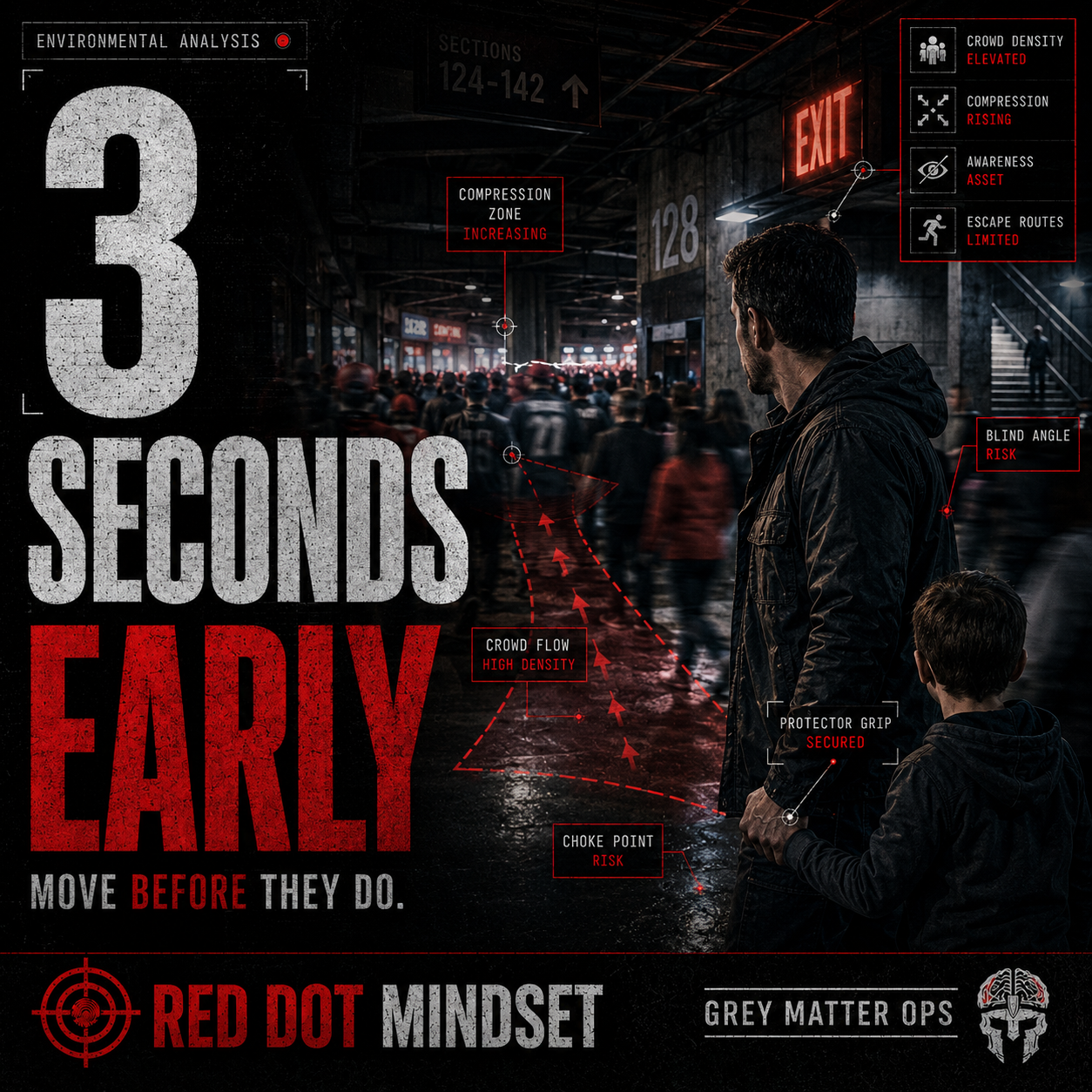
[00:25] Speaker B: Exactly. But today we're going to explore why moving just three seconds earlier than the rest of that crowd is literally the difference between life and death.
[00:33] Speaker A: And that is exactly why we're doing this deep dive today. We are taking you — yes, you listening right now — through a really comprehensive civilian awareness briefing. It's from Grey Matter Ops, and it's titled "Surviving the Surge: Navigating High Alert Environments in 2026."
[00:48] Speaker B: It's a fantastic document. Highly detailed.
[00:50] Speaker A: It really is. Yeah. And the mission of this deep dive is to give you a shortcut to navigating public spaces — you know, stadiums, transit hubs, those massive outdoor festivals — with absolute confidence. We want to replace that fear of the unknown with the calm, disciplined observation of a professional.
Okay, let's unpack this, right?
[01:13] Speaker B: Let's get into it.
[01:13] Speaker A: The entire foundation of this briefing is built on finding what they call the professional middle ground. Because when the news cycle gets really intense, people tend to swing wildly between two extremes.
[01:24] Speaker B: Yeah, they really do.
[01:25] Speaker A: On one side, it's total denial — like, oh, nothing bad will ever happen to me. And on the other side, it's this paralyzing fear. I can never take my kids to the mall ever again.
[01:33] Speaker B: And neither of those extremes is practical. I mean, neither one actually keeps you safe. If we connect this to the bigger picture, what we are really talking about is living on a very specific timeline.
[01:44] Speaker A: The timeline of an incident.
[01:46] Speaker B: Right. Security professionals use the phrase "left of bang." So think of a timeline where the bang is the actual incident — a crisis, a crowd surge, some kind of emergency. That's the bang. Everything that happens after that incident is right of bang. That is where you're reacting, you're scrambling, you're just surviving.
But left of bang is everything that happens before. It's the preparation, the observation, your positioning.
[02:10] Speaker A: So you're basically trying to stretch out that left of bang period as much as possible so you're never caught off guard.
[02:15] Speaker B: Precisely.
[02:16] Speaker A: And I really love that the Grey Matter Ops doctrine makes it super clear that this is not about paranoia. It's about treating situational awareness as a trainable habit.
[02:26] Speaker B: It's just like looking both ways before you cross the street. You don't do that because you're terrified of cars, right?
[02:31] Speaker A: No, of course not.
[02:31] Speaker B: You do it because it's a simple, reliable protocol. It keeps you safe.
[02:35] Speaker A: But before we get into the physical tactics, we really have to look at the environment itself, because the term "high alert" just scares people. You hear that and you immediately picture sirens and chaos.
[02:48] Speaker B: Sure, but in the professional intelligence world, "high alert" just means the sensors are live and the guardrails are being reinforced.
[02:55] Speaker A: It's more of a behind-the-scenes shift.
[02:57] Speaker B: Yeah. When governments or local agencies shift their security posture, they are just signaling that visible patrols are increasing and intel is being shared faster. It's a shift in readiness.
[03:09] Speaker A: It's a shift in readiness, not a guarantee of an actual incident.
And we so often confuse possibility with probability. I mean, statistically speaking, you are far, far more likely to get into a fender bender in the stadium parking lot than you are to encounter a coordinated threat inside the venue.
[03:28] Speaker B: Absolutely. We train for the possibility so we can completely stop obsessing over the probability.
[03:33] Speaker A: Which brings us to a really interesting concept the briefing calls the convenience trap.
[03:38] Speaker B: Oh, this is a big one. We tend to assume these massive public spaces are safe just because there are guards at the doors or metal detectors, right? But soft targets — like malls and stadiums — they aren't vulnerable because the people inside are weak. They are vulnerable because of their architecture.
[03:54] Speaker A: Yeah, think about the design of a fortress versus a mega mall. A fortress is literally engineered to keep people out. It has moats, high walls, you know, choke points.
[04:03] Speaker B: And a modern stadium is the exact opposite.
[04:06] Speaker A: The exact opposite. It's structurally engineered to pull 70,000 people inside, get them to the concession stands, and get them to their seats with zero friction. The entire design prioritizes maximum flow.
[04:20] Speaker B: Maximum flow and maximum convenience. And that gap between convenience and defense is exactly where the vulnerability lives.
Especially when you factor in what they call the 72-hour copycat window —
[04:32] Speaker A: — which is when a highly publicized event dominates the news cycle.
[04:35] Speaker B: Yeah. It naturally triggers a contagion window where imitation attempts temporarily spike.
[04:40] Speaker A: It's basically like checking the weather. I mean, if the forecast calls for severe storms, you don't just cancel your life and hide in the basement. You just grab an umbrella and pay closer attention to the sky.
[04:50] Speaker B: That's a great way to look at it.
[04:51] Speaker A: So during that 72-hour window, you deliberately dial your awareness from a baseline 5 up to an 8. You aren't carrying this heavy burden of fear. You're just driving with your hands at 10 and 2 instead of resting one finger on the wheel.
[05:04] Speaker B: And if you are driving with your hands at 10 and 2, you actually become part of the security apparatus before you even reach your seat.
[05:10] Speaker A: You become a civilian sensor.
[05:12] Speaker B: Exactly. You are a sensor, not a vigilante.
[05:14] Speaker A: Here's where it gets really interesting, though. Because it's so easy to say, hey, be a sensor, look for anomalies. But let's be real — I'm a parent. If I'm dragging two kids through a crowded concourse, I'm holding overpriced hot dogs, and there are thousands of people swarming around me. If I try to analyze every single person I walk past, my brain is going to short circuit.
[05:36] Speaker B: Oh, for sure. You'd be exhausted in five minutes.
[05:39] Speaker A: So how do you actually process that massive volume of data without just going crazy?
[05:45] Speaker B: Well, you don't analyze everyone. That is the secret. You only analyze the baseline.
[05:50] Speaker A: The baseline?
[05:51] Speaker B: Yeah. Every environment has a behavioral heartbeat — that's the baseline. So at a summer music festival, the baseline is relaxed. People are wearing light clothing, they're moving fluidly, talking loudly.
[06:01] Speaker A: Makes sense. But —
[06:02] Speaker B: But in a museum, the baseline is totally different. It's quiet, slow, deliberate movement. You don't walk in looking for threats. You just calibrate your brain to what normal feels like in that specific room.
[06:15] Speaker A: Ah, so when you truly know the baseline, the anomaly just reveals itself.
[06:19] Speaker B: Right.
[06:20] Speaker A: It's kind of like listening to a song you know by heart. If the guitarist hits one wrong chord, you don't have to be actively analyzing the sheet music to cringe. Your brain just flags it — like, whoa, that doesn't belong.
[06:32] Speaker B: That's a perfect analogy. And the most critical doctrine here is that behavior matters more than identity. We aren't profiling what people look like. We are profiling what they are doing.
[06:43] Speaker A: So what does an anomaly actually look like?
[06:45] Speaker B: Well, a classic one is the concealment anomaly — like someone wearing a heavy trench coat in August.
But there are much deeper pre-incident psychological cues. Take the security rub.
[06:57] Speaker A: I found this part so fascinating. The security rub is when someone subconsciously touches a concealed area of their body — like their waistband or their chest.
[07:06] Speaker B: Yes. Because human beings constantly seek tactile reassurance.
[07:10] Speaker A: We want to know our stuff is there.
[07:12] Speaker B: Exactly. If you are carrying something valuable or dangerous — whether it's an envelope full of cash or a concealed weapon — and you are walking into a high-stress environment, your brain will subconsciously compel your hand to bump or tap that item just to confirm it's still there.
[07:27] Speaker A: That makes total sense. I literally check my pocket for my keys three times when I'm walking to my car in a dark lot. It's the exact same psychological mechanism.
[07:35] Speaker B: It is. And then there's scanning the six.
[07:37] Speaker A: Right. Looking backwards.
[07:38] Speaker B: Yeah. Most people walking into a stadium are looking at the field, the signs, or staring at their phones. An anomaly is someone constantly looking backwards, scanning over their shoulder at the security checkpoint. They're demonstrating a predator-prey dynamic — they're tracking the authorities rather than the event itself.
[07:55] Speaker A: Exactly. And the most jarring one to spot is the anti-freeze tell.
[07:59] Speaker B: What's that?
[08:00] Speaker A: Imagine 70,000 people are cheering, relaxed, moving fluidly — and one person is completely rigid, hyper-focused, showing zero emotional response to the environment. That rigidity completely breaks the baseline.
[08:15] Speaker B: But the briefing makes a really brilliant point here. You don't wait until you're face to face with the anti-freeze tell to make a plan.
[08:22] Speaker A: Right. That's too late.
[08:23] Speaker B: You control the variables before you even leave your house. They talk about virtual recon, which completely changes the game. Just spending five minutes on your phone looking at the venue map to locate the stairwells.
[08:35] Speaker A: Because human beings are fundamentally lazy — we naturally gravitate toward elevators.
[08:40] Speaker B: Always.
[08:41] Speaker A: But in an emergency, an elevator is just a metal trap that's going to lose power. You need to know where the concrete stairs are.
[08:48] Speaker B: And that strategic thinking extends all the way to the parking lot. Most people want the VIP spot, right? The one right next to the main gate.
[08:55] Speaker A: The convenience trap strikes again.
[08:57] Speaker B: Yes. But that main gate is a massive choke point. If an evacuation happens, every single person rushes those main doors and the closest parking lots gridlock instantly.
[09:09] Speaker A: Which is why the doctrine teaches: park on the periphery of the lot, back your car into the space, and face your primary exit route out to the main road.
[09:17] Speaker B: You want to be the very first vehicle flowing out, not the 500th car boxed in by terrified pedestrians.
[09:23] Speaker A: Exactly. And you pair that with the surge factor.
[09:26] Speaker B: Timing your arrival.
[09:27] Speaker A: Right. Timing it to either beat the massive crowd at the security gates or waiting until after the rush. Because a static, compressed crowd waiting to get through metal detectors is incredibly vulnerable. You always want to stay fluid.
[09:41] Speaker B: Which perfectly transitions us to what happens once you are actually inside the venue. Because this is where observation shifts into physical positioning. They call it the Environmental Geometry Framework, or EGF.
[09:53] Speaker A: Yes. I want to break this down because it totally shifted how I view physical space in public.
[09:58] Speaker B: Yeah.
[09:59] Speaker A: The golden rule here is: space dictates risk. The center of any dense crowd is the highest risk zone for mobility.
[10:06] Speaker B: They call it the compression trap.
[10:07] Speaker A: Right. Because if you are standing in the dead center of a floor-admission concert and a panic starts, the physical weight of the human bodies around you removes all your agency. You literally cannot step left or right.
[10:18] Speaker B: That is exactly why trained professionals instinctively drift toward the perimeter. The edges of a room or the edges of a crowd give you lateral movement. If pressure pushes forward, you can step sideways.
[10:29] Speaker A: And you really have to understand how architecture manipulates that crowd pressure. There is a vital difference between a choke point and a funnel zone.
[10:38] Speaker B: A huge difference. A choke point restricts your movement entirely — like a narrow hallway where you can only go forward or backward. But a funnel zone takes a massive, wide crowd and compresses them toward a single opening.
[10:51] Speaker A: Think about a huge stadium concourse dumping out into the main exit gates.
[10:55] Speaker B: Exactly. And knowing those zones is why you have to establish a physical anchor before anything happens. The Big Blue Clock protocol.
[11:04] Speaker A: I love this one. Because when a family walks into a venue, the parents usually just say, "Okay, kids, stay close. Hold my hand."
[11:10] Speaker B: That is a hope. It is not a tactical plan.
[11:12] Speaker A: Because if a surge happens, you will get separated. And in a true emergency, local cell towers get instantly overloaded by tens of thousands of people trying to call 911 or their families at the exact same second. The network drops. You can't text, you can't call.
[11:27] Speaker B: So you establish an undeniable physical landmark the absolute second you arrive. You say: if we get separated, we do not wander. We meet at the big blue clock above section 104.
[11:38] Speaker A: It removes the decision-making from a moment of panic.
And speaking of panic, we have to talk about escaping the exit trap and this terrifying psychological glitch.
[11:48] Speaker B: We all have normalcy bias.
[11:50] Speaker A: Yes. When an emergency happens, people will instinctively turn around and try to run out the exact same door they used to walk in.
[11:57] Speaker B: Even if there are three glowing emergency exits right next to them.
[12:01] Speaker A: Exactly. It's the known door trap.
[12:03] Speaker B: Right. Under extreme stress, the brain just defaults to familiar pathways. It cannot process new navigational data efficiently.
[12:12] Speaker A: Which is why the two-exit rule is just a foundational habit. The moment you sit down at a restaurant or a theater, you identify your primary exit — the one you walked through — and you actively force your brain to locate an obscure secondary exit.
[12:24] Speaker B: The kitchen door. The side service corridor.
[12:27] Speaker A: Right. You are preloading that navigational data so your brain doesn't have to compute it while adrenaline is flooding your system.
[12:33] Speaker B: And if you do get caught in a crowd surge moving toward one of those exits — like a funnel zone — you have to use the 45-degree rule.
[12:40] Speaker A: This was the light-bulb moment for me. Moving through a funnel zone during a panic is exactly like swimming parallel to the shore when you're caught in a rip current.
[12:49] Speaker B: Yes. Perfect analogy.
[12:51] Speaker A: If you try to fight straight backward against the pressure of the crowd, you will get trampled. The physics of the mass will just overwhelm you. You have to angle out diagonally — 45 degrees — moving toward the edges of the flow to escape the crush under pressure.
[13:05] Speaker B: It's pure fluid dynamics. You are moving with the flow, but cutting to the perimeter to retain your footing. And if you are guiding a child through that rip current, you never hold their hand.
[13:15] Speaker A: You use the protector grip.
[13:16] Speaker B: Yes. You grip them firmly by the wrist or the lower forearm. Finger locks are structurally weak.
[13:23] Speaker A: They just pull apart.
[13:24] Speaker B: Exactly. If someone bumps into you during a surge, your fingers will break apart instantly. Grabbing the wrist creates a skeletal structural connection that will not snap under pressure.
[13:34] Speaker A: So, okay — geometry and exits are obviously vital. But let's be honest, none of that matters if your legs literally refuse to work when the moment actually happens. We have to dive into the human brain and what Grey Matter Ops calls the vibe shift.
[13:49] Speaker B: Because everything we just talked about relies on recognizing that shift and breaking the freeze.
[13:54] Speaker A: Right. So what is the vibe shift?
[13:57] Speaker B: The vibe shift is that subtle pre-kinetic environmental change — those few seconds before the bang. It might be an unnatural silence. It might be a directional shift where a massive group of people suddenly turn and move the wrong way.
[14:11] Speaker A: Or even an animal disturbance, right? Like birds suddenly scattering from the stadium rafters.
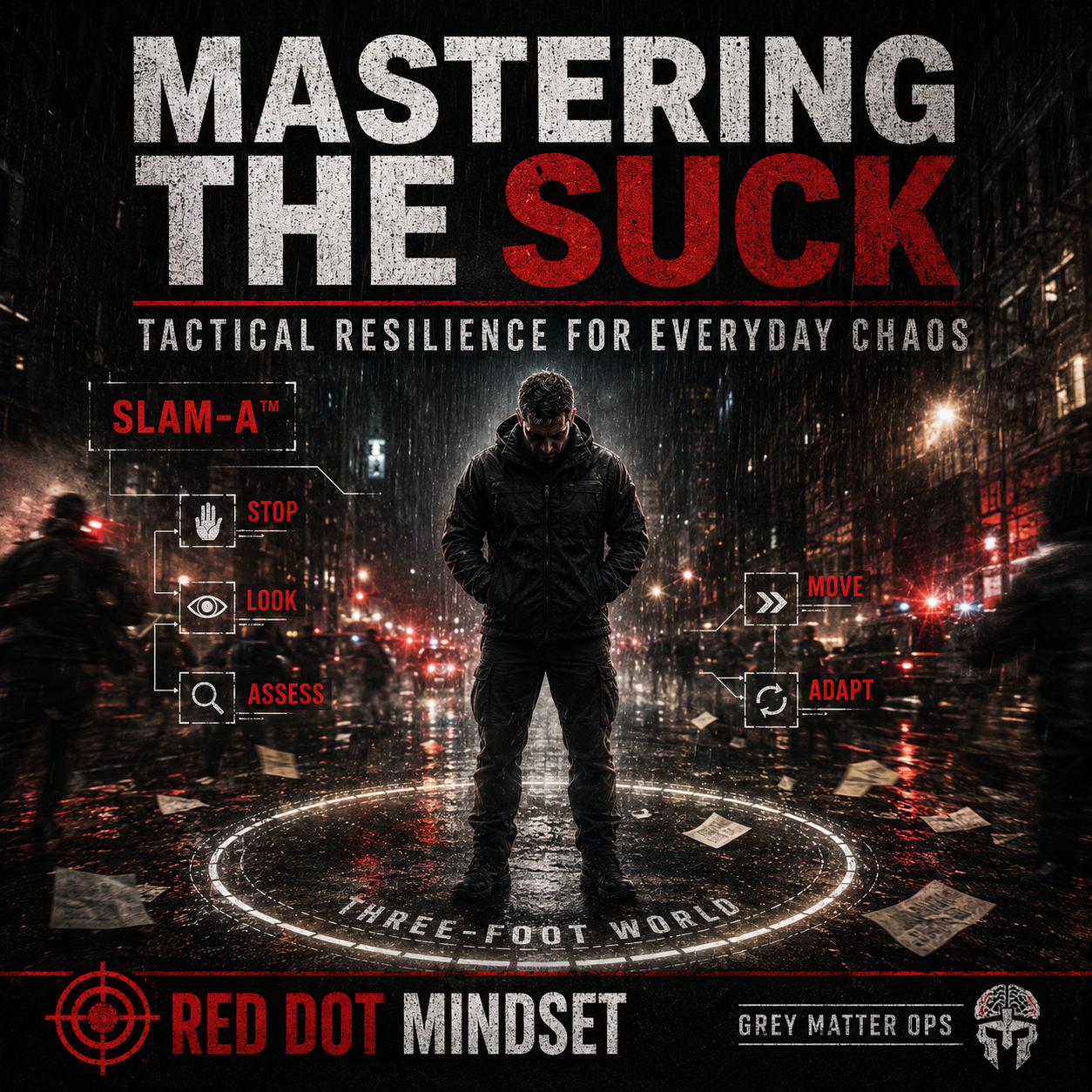
[14:15] Speaker B: Exactly. And when that shift hits, the sheer scale of the environment can paralyze you. The doctrine says you have to immediately shrink your reality down to the three-foot world.
[14:25] Speaker A: Meaning you stop worrying about what's happening on the other side of the stadium.
[14:28] Speaker B: Right. You narrow your focus to three things: your immediate family, your distance from the physical surge, and your nearest escape vector.
[14:36] Speaker A: Because if you try to analyze the entire geopolitical landscape of the threat in that moment, you will experience one of the three freezes.
[14:45] Speaker B: Physiological, mental, and social.
[14:48] Speaker A: Break those down for us.
[14:49] Speaker B: Well, the physiological freeze is the adrenaline dump. Your body prepares for combat. Blood rushes to your core, and your limbs literally feel heavier — locked. The mental freeze is a cognitive loop of denial.
[15:03] Speaker A: Like, "That sounded like a gunshot." "No, it's just a firework."
[15:06] Speaker B: "Maybe it was a speaker popping." Yeah, your brain loops because it rejects the awful reality.
[15:10] Speaker A: But I think the social freeze is probably the most dangerous one for the average person.
[15:14] Speaker B: Oh, without a doubt.
[15:15] Speaker A: Because we are so terrified of overreacting. We don't want to be the crazy guy who screams and runs for the exit because somebody just dropped a keg of beer. So how do you give yourself permission to move when every other person around you is just standing there staring?
[15:28] Speaker B: By internalizing the 3-to-5 second decision window. In a crisis, the crowd will wait for social proof. They will literally wait for an authority figure to tell them to run. But the prepared individual knows that action always beats analysis. The rule is incredibly forgiving. Moving 20 yards toward an exit and then realizing it was just a dropped keg is completely fine.
[15:51] Speaker A: Feel a little silly for a minute.
[15:52] Speaker B: Exactly. You feel silly. But staying fixed in place to wait for confirmation — and realizing the threat is real — that costs you your life.
[16:00] Speaker A: So to break that stall, they teach the anti-freeze protocol, which feeds into the Grey Loop decision cycle. It's basically a four-tier physical conversion to get your brain back online.
[16:11] Speaker B: Tier one is recognize. You literally say out loud to yourself, "I'm locked."
[16:16] Speaker A: Acknowledging it breaks the spell a bit.
[16:18] Speaker B: Right. Second is micro movement. You don't try to sprint. You just shift your weight from your left foot to your right foot, or you grab your partner's wrist. You just break the physical stillness.
[16:27] Speaker A: That micro movement acts as a biological reset switch. Once you move an inch, you can move a mile.
[16:32] Speaker B: Exactly. Step three is action — you commit to the secondary exit you preloaded earlier. And step four is flow. Now that you are moving, you re-enter your observation loop. You assess the terrain as you move.
[16:45] Speaker A: Okay. So you've broken the freeze, you've navigated the geometry, hit your secondary exit, and you are outside — far away from the danger. The bang is behind you. But the tactical mindset does not end at the exit doors.
This is where we get into the aftermath — the post-incident reset protocol.
[17:02] Speaker B: The first 30 minutes after escaping the immediate threat are highly critical. And the very first action upon reaching a safe position is the plug sweep.
[17:11] Speaker A: This sounds intense, but it is so necessary. When your system is flooded with that much adrenaline, it acts as a massive painkiller.
[17:20] Speaker B: It does.
[17:20] Speaker A: You could be suffering from shrapnel or lacerations and have zero pain receptors firing. You literally have to run your hands over your own body and your children's bodies, checking for wetness or trauma.
[17:31] Speaker B: And once you confirm physical integrity, you have to actively signal your nervous system that the acute danger has passed. Use the decompression loop. And the core of this is 4-2-7 anchor breathing.
[17:42] Speaker A: I want to explain the biology of this, because it isn't just some meditation trick. You inhale for four seconds, hold for two, and exhale for seven seconds.
[17:50] Speaker B: The exhale is the key, right?
[17:52] Speaker A: Why the long exhale? Because exhaling longer than you inhale physically stimulates the vagus nerve. The vagus nerve is the biological brake pedal for your heart. It forces your parasympathetic nervous system to take over, which literally turns off the fight-or-flight adrenaline drip.
[18:08] Speaker B: You combine that physiological brake with physical grounding — you know, noticing the temperature of the air, listening to a specific sound. It stops the mental panic loop.
[18:17] Speaker A: And once you are grounded, your role as a civilian sensor activates one last time through the Social Behavioral Shield Protocol, or SBSP.
[18:26] Speaker B: This is all about how you interact with law enforcement or 911 dispatchers. The golden rule is: report data, not feelings.
[18:34] Speaker A: Yeah. If you run up to a police officer and scream, "There's a really suspicious guy giving me bad vibes" —
[18:38] Speaker B: Yeah.
[18:38] Speaker A: — that gives them absolutely nothing to work with. They can't act on your anxiety.
[18:42] Speaker B: They need actionable intelligence. That's why Grey Matter Ops relies on the SALUTE framework: size, activity, location, uniform, time.
[18:50] Speaker A: It strips away all the bias and emotion. So instead you say — size: three individuals. Activity: they bypassed the ticket line and were filming the hinges on the emergency exit doors. Location: north concourse, near Gate 4. Uniform: one wearing a red jacket, two in black hoodies. Time: three minutes ago.
[19:11] Speaker B: That is a laser-guided piece of intelligence.
[19:14] Speaker A: And lastly, you must maintain what they call tactical discipline. This is perhaps the hardest thing for people to do today — a complete social media blackout.
[19:22] Speaker B: This raises an important question, doesn't it? Our immediate modern instinct is to pull out our phones and start live streaming the chaos. "Look what's happening."
[19:29] Speaker A: Oh, absolutely. Everyone wants to be the reporter.
[19:31] Speaker B: But filming an active event directly conflicts with the foundational mandate of survival, which is creating distance and staying left of bang. If you are looking through a screen, you lose your peripheral vision. Your situational awareness drops to zero, and you are basically tethering yourself to the danger zone.
[19:48] Speaker A: You document privately if you need to preserve your memory for authorities. But you do not post it, you do not tag the location, and you absolutely never return to the scene to get a better look or play vigilante.
[20:01] Speaker B: Never.
[20:01] Speaker A: The civilian's job is observation and responsible reporting. Period. Leave the confrontation to the professionals.
[20:08] Speaker B: The overarching theme of this entire doctrine — from avoiding the convenience trap to the vagus nerve breathing — is that preparedness creates freedom. It does not create fear.
[20:18] Speaker A: Right. When you know how to read a room and how to exit it, you can actually relax and enjoy the event.
[20:23] Speaker B: It replaces confusion with disciplined action. And to help you actually build this muscle, we want to leave you with the 30-second drill.
[20:31] Speaker A: Tomorrow, when you walk into a grocery store, a coffee shop, or your office building, just do this one thing.
[20:36] Speaker B: So simple.
[20:37] Speaker A: Locate the front door you just walked through. Then stop, look around, and actively find one tactical alternative exit you have never used before — an employee door, a loading dock, a stairwell. It takes 30 seconds. You aren't being paranoid. You are simply removing surprise from the equation.
[20:53] Speaker B: You are building environmental fluency. It becomes muscle memory.
[20:57] Speaker A: And looking at all of these frameworks, it leaves me with this one thought I just haven't been able to shake since reading this brief. We spend all this time talking about left-of-bang awareness — you know, actively noticing the baselines of the environments we are in, paying real focused attention to the subtle behaviors of the strangers around us, taking our faces out of our phones, being present.
[21:21] Speaker B: Exactly.
[21:22] Speaker A: What if constantly practicing this tactical awareness inadvertently trains us to just be more present? Think about it. If you train yourself to notice the subtle body language shifts of strangers in a crowd, imagine how much more attuned you become to the subtle emotional shifts of your own kids at the dinner table. What if observing the world this closely — for the sake of security — actually makes us more empathetic, attentive listeners in our everyday lives? What if tactical awareness actually makes us better humans in peacetime?
[21:50] Speaker B: That is a really profound perspective. Attention is the single most valuable thing we can give to our environment — and ultimately to each other.
[21:56] Speaker A: Well, thank you for joining us on this deep dive. We really hope you take these tools with you — and keep your eyes up, move with margin. And remember: situational awareness is a habit, not a burden. Once it's built, you only feel the confidence. We'll catch you next time.