Episode Transcript
[00:00] Speaker A: Welcome back to the Deep Dive. Today we're on a mission that's a bit more involved than just talking about awareness. Our goal is to fundamentally redefine how you interact with your environment. We want to move you beyond just passively looking at the world to actively reading the terrain.
[00:16] Speaker B: And that shift is everything — from passive looking to active reading. That spatial intelligence. The terrain is always speaking, and we're here to teach you its language.
If you understand the Environmental Geometry Framework™, you get that geometry influences behavior.
It dictates risk long before a threat ever becomes visible.
[00:36] Speaker A: That's the crucial difference, isn't it? We're diving deep into that core system — the Environmental Geometry Framework™, or EGF. This is the Grey Matter Ops™ way of interpreting your surroundings, seeing the environment not as some static background, but as a living map of risk and opportunity.
[00:51] Speaker B: Exactly. A dynamic map. And today we'll unpack the five pillars of EGF. We're going to show you how mastering concepts like compression, isolation, and exposure moves you decisively out of condition white. The whole point here is singular — to give you the spatial data you need to stay firmly left of bang.
[01:10] Speaker A: Okay, let's start with that mental shift. We talk a lot about the Grey Protector Mindset Doctrine, but how does it apply specifically to spatial awareness? Where do most people begin?
[01:20] Speaker B: Most people start — and honestly stay — in condition white, the unaware. They're physically there, you know, walking down a street, but cognitively they're absent. Eyes are glued to screens, earbuds are in, blocking out everything. And they operate with zero awareness of exits, escape routes, or even who is behind them. They just assume danger is someone else's problem.
[01:38] Speaker A: Which is the most dangerous assumption you can make. So what does condition grey look like in practice — through this lens of geometry?
[01:45] Speaker B: Condition grey is the prepared.
You're not paranoid, you're not trying to stand out, but you are constantly absorbing 360° of information.
You move with purpose. You're reading rooms as you enter them. You're staying two steps ahead. And EGF is the mechanism for that state. It's what defines the spatial mindset.
[02:04] Speaker A: And this mapping teaches us to see the world shaped by those three conditions you mentioned — compression, isolation, and exposure. Can we define those again, maybe with a clear example of how they create risk?
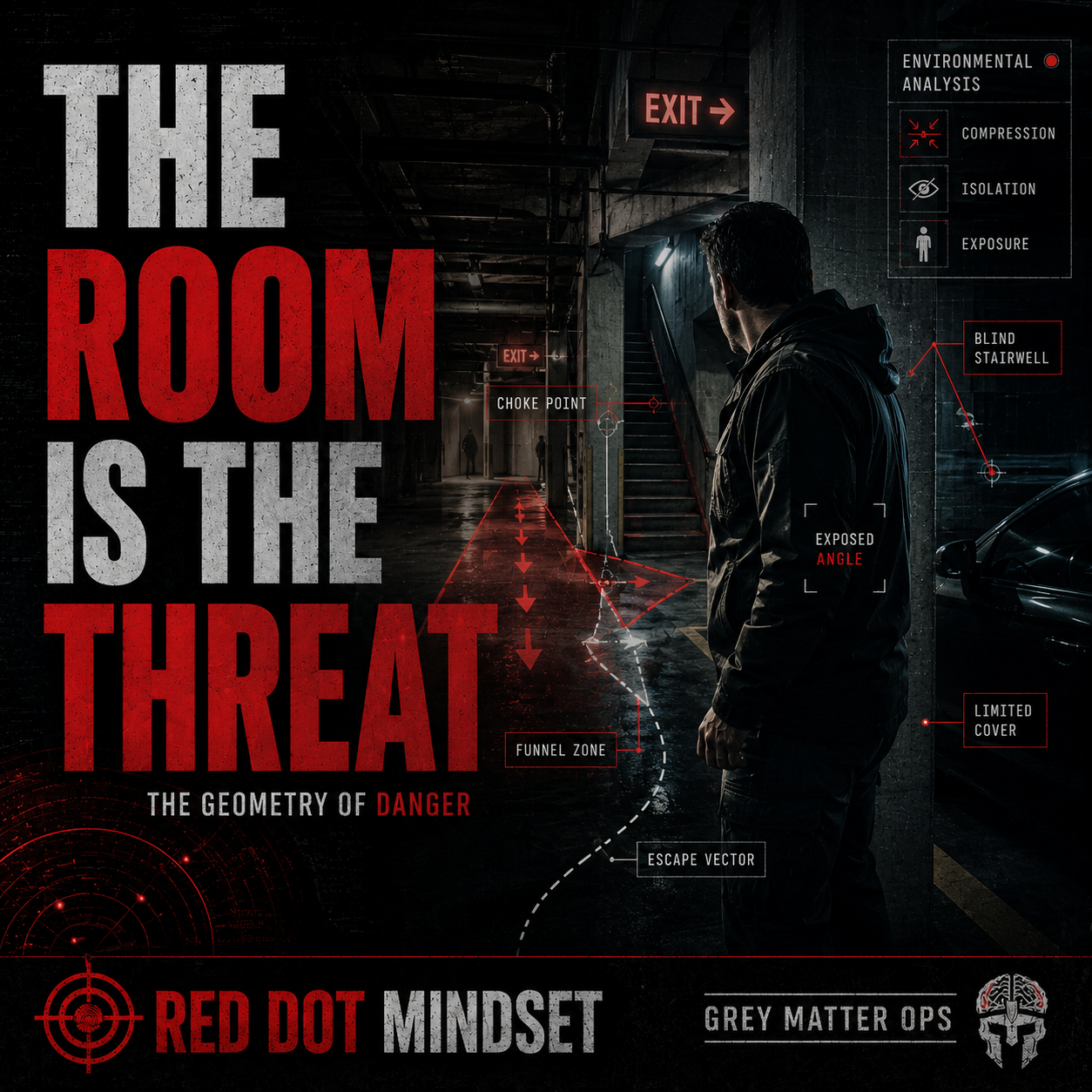
[02:16] Speaker B: Absolutely. Think of them as the three big geometric red flags. Compression is where movement bottlenecks, where your personal space gets squeezed. It forces people into very predictable patterns — like walking single file through a narrow construction barricade. That's high compression.
[02:32] Speaker A: Okay. And isolation?
[02:33] Speaker B: Isolation is where you can't be seen or heard. A blind stairwell, a poorly lit section of a parking garage — anywhere witnesses and security are basically absent. And exposure is the opposite. It's where you're completely visible, maybe silhouetted against a bright background, making you a very obvious, very vulnerable target.
[02:50] Speaker A: So if the environment is always presenting one of those three states, the advantage of EGF is that it's purely about anticipation. You're hunting for the risk before you ever see a threat.
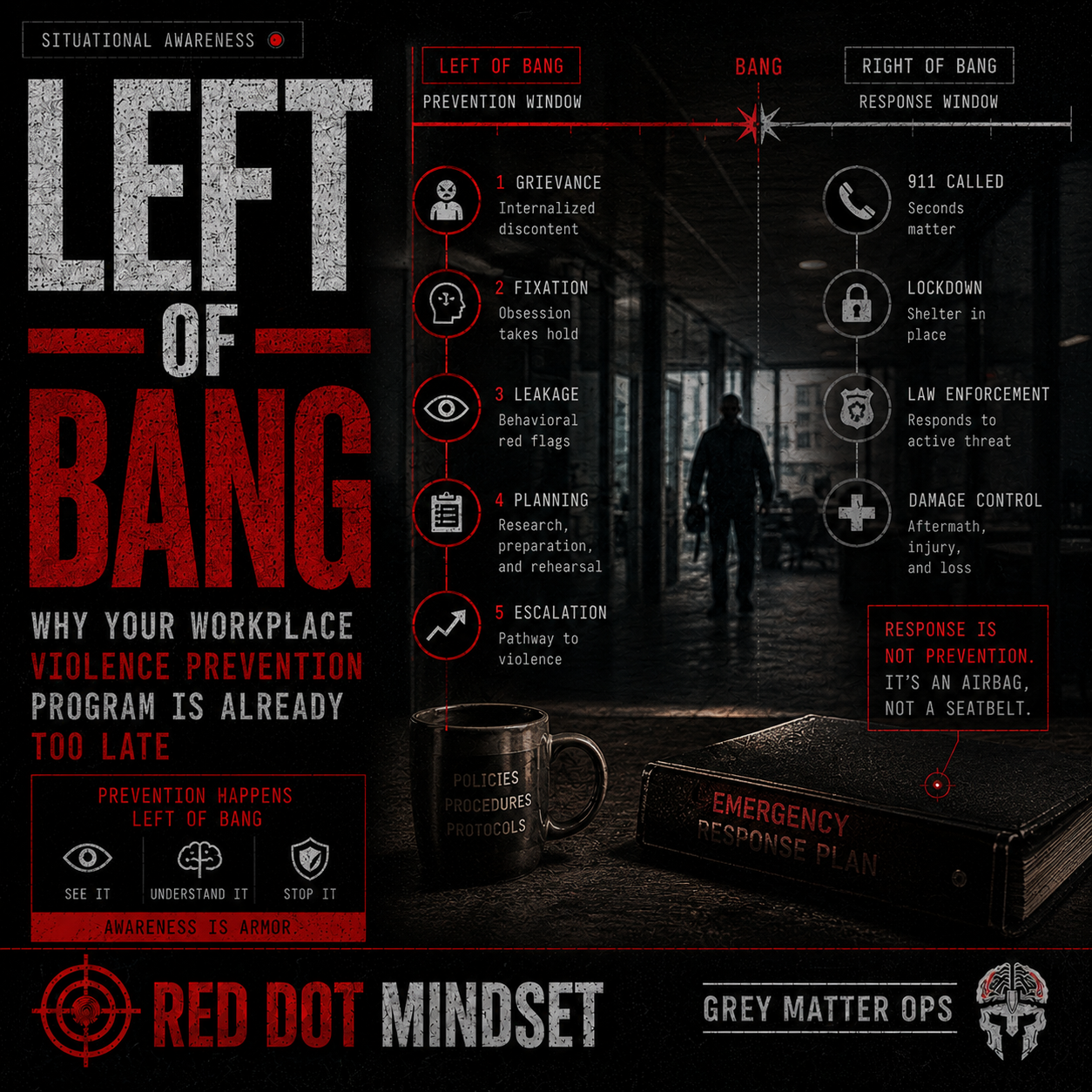
[03:01] Speaker B: That is the absolute definition of left of bang. We're not waiting for something bad to happen. We're recognizing the geometric setup that makes it possible.
The doctrine is clear. Geometry dictates opportunity. An environment with high isolation and high compression — a hostile actor knows that gives them time, cover, and a predictable target.
EGF forces you to see that setup first.
[03:23] Speaker A: That detail is exactly what we need. Okay, let's get into the specifics. EGF has five pillars. They're designed to give you that input layer for making tactical decisions. Let's start with pillar one — choke points and funnel zones.
[03:35] Speaker B: Right. These are your highest risk areas because they kill your options. They restrict movement. We have to be clear on the difference, though. A choke point restricts individual movement — think a single doorway, a turnstile, an elevator car.
[03:46] Speaker A: Just one or two people at a time.
[03:47] Speaker B: Exactly. But a funnel zone is about crowd dynamics. It forces a whole crowd through a confined opening — the exit of a concert, a subway platform at rush hour. It dramatically increases density and, well, chaos.
[04:02] Speaker A: And we see these everywhere. The source material uses the parking garage as a prime example.
[04:06] Speaker B: It's the perfect geometry lab for risk. You have the obvious choke points — stairwells, elevators, blind corners.
But the detail people miss is the 18-inch gap between parked cars. That little space forces you into a straight line. It kills your ability to move laterally to evade. You're physically compressed.
[04:23] Speaker A: What about something we walk through every day, like a building vestibule?
[04:27] Speaker B: Vestibules are classic transitional zones, and they are dangerous. It's an airlock. It forces you to pause as you move from outside to inside. You're fumbling for your keys, your phone. That little stall — where you are literally compressed between two doors — is a critical fumble zone. Your awareness drops and your exits are limited at the exact moment you're most predictable. The rule is: always see where you have to move single file, and plan your exit before you even enter.
[04:52] Speaker A: Okay, so once we spot these high-risk compression zones, the next step is figuring a way out. Which brings us to pillar two — escape vectors.
[05:01] Speaker B: Absolutely. And this is the difference between luck and a plan. The plan has to be preloaded. You need to identify a primary and a backup escape path before you sit down or settle in anywhere. You're looking for obstacles — furniture, crowds, anything blocking your way.
[05:16] Speaker A: Let's use the parking garage again. How does this apply before you even walk to your car?
[05:21] Speaker B: Before you take a single step toward your vehicle, you identify the nearest stairwell, the nearest ramp, and any open-air exit.
The idea isn't that the elevator will be broken. The idea is that the stairwell is faster and the ramp gives you more room to move if you need to disengage from a threat.
This same thinking applies directly to the tactical seating protocol.
[05:41] Speaker A: This protocol is so useful. I realize now I almost always pick a comfortable booth — but you're saying I'm basically walking into a tactical trap.
[05:48] Speaker B: You are. When you choose a seat in a restaurant, mobility has to be the priority, not comfort.
Booths are natural containment zones. They kill your ability to move sideways or backward. You're boxed in. You want to avoid deep corners and any fixed seating. You need to ensure you can move unrestricted the second you detect something is wrong.
[06:09] Speaker A: Freestanding tables near a wall seem like a much better option then?
[06:14] Speaker B: Far superior. You get the wall for protection, but you keep your mobility.
[06:17] Speaker A: Okay, on to pillar three — light discipline. We think of light as safety, but EGF shows how it can be a huge vulnerability. Pure exposure.
[06:26] Speaker B: It's a double-edged blade for sure. It can expose you or it can give you concealment. Your assessment has to be: Am I illuminated? Am I silhouetted? Or am I concealed? The big rule is to avoid standing fully backlit — framed in a bright doorway at night. You become a perfect target for anyone watching from the dark.
[06:43] Speaker A: The sensory mapping of the parking garage really drives this point home — the high contrast of the light there.
[06:48] Speaker B: Yes, that environment is all about inconsistent lighting. You have that sickly yellow glare, then total darkness. It makes it hard for your eyes to adjust, and it creates these long, deep shadows that can play tricks on you — create false targets. The principle for movement is to stay within pools of moderate light. And if you have to use a flashlight or your phone, keep it angled low. It disrupts an aggressor's vision and helps you create distance.
[07:12] Speaker A: Next up, pillar four — sound. How does the geometry of a space affect what we can and can't hear?
[07:20] Speaker B: Sound can mask your movement or it can betray your position. And the number one most crucial rule is to never wear earbuds in transitional spaces. They decimate your auditory awareness. You won't hear those critical early warnings — footsteps speeding up behind you, heavy breathing, things like that.
[07:36] Speaker A: What if the environment is just loud, like a busy street?
[07:38] Speaker B: Then you have to understand that it's providing cover for an adversary just as much as it is for you. Take a concrete stairwell — the whole shaft acts like a drum. It amplifies loud noises: a door slamming, boots on the steps. But it can actually hide subtle sounds, like the rustle of clothing. In a loud parking garage, the hum of the ventilation fans can mask the sound of footsteps until it's too late. When your sound intelligence is low, your visual scan has to go way up.
[08:06] Speaker A: That makes sense. Finally, pillar five — geometry of position. This really ties it all together, connecting the analysis to where you physically place yourself.
[08:15] Speaker B: Right. Your choice of position is a critical tactical decision. It's about maximizing what you can see while minimizing your own vulnerability.
You're looking for a dominant vantage point — a spot that gives you a panoramic view of all the main entrances and exits. And you never, ever expose your back to an open area.
[08:32] Speaker A: And what's the one spot in any venue we should always avoid?
[08:36] Speaker B: You have to stay off the X. The X is the primary entrance — it's a natural bottleneck for any hostile actor coming in. And it becomes an absolute kill zone during a mass exodus when people panic. You want to be adjacent to a secondary or tertiary exit. Always maximize your mobility — freestanding tables, not fixed booths. And this is key: keep a bit of standoff distance from the wall, maybe 18 inches. If you're pinned right against it, you've just cut your movement options in half.
[09:03] Speaker A: So EGF gives us this incredible spatial input. It teaches us how to see the hazards. Now, how does the mind actually process that data and turn it into action when a threat appears?
[09:13] Speaker B: You need a system for processing the data EGF gives you. That's where we bring in the OERA model — Observe, Effect, Recognition, Absence.
[09:21] Speaker A: Okay, can we walk through OERA quickly? Let's say we're observing a restaurant lobby.
[09:25] Speaker B: Sure. First you observe — taking in the whole environment: geometry, light, sound, all of it.
Then effect.
How does that environment shape behavior? Is the host stand creating a choke point? Is the bar area a funnel zone?
Then recognition. You're looking for deviations from the baseline. If everyone is calm and one person is moving erratically — or is positioned in a weirdly advantageous spot, like near a service door — that's a deviation you need to recognize.
[09:52] Speaker A: And then the last one, which is really advanced — absence.
[09:55] Speaker B: Absence is often your earliest warning. You're noticing what isn't there but should be — a fire exit that's not lit, a security guard who is missing from their post. Absence can signal concealed intent long before you see any overt action. OERA is what turns EGF's passive data into an active threat assessment.
[10:12] Speaker A: And if that assessment confirms a threat, recognition has to trigger immediate action to avoid freezing up. So this links EGF directly to the anti-freeze protocol.
[10:20] Speaker B: That's its primary job. EGF gives you that early recognition, and that shortens the critical zero-to-two-second window where people freeze. And because you already pre-identified your escape vectors with pillar two, you have a preloaded script for the action tier. You don't have to waste time deciding where to go. You just execute the plan.
[10:39] Speaker A: The final step is action, guided by that geometry. This is the movement phase of the Grey Protocol.
[10:44] Speaker B: And the goal always is escape. You are not fighting, you are not negotiating — you are moving. You use the safe geometry you already mapped out. And the first move — we have to keep reinforcing this — is a single lateral step.
Stay off the X. Break the attacker's calibration.
[11:00] Speaker A: And never retreat straight back.
[11:03] Speaker B: Never. It's slow, it's clumsy, and it's what they expect. You need angled movement — a 45-degree angle or a lateral shift toward one of your escape vectors. Better yet, use a J-curve. Move sideways first, using cover if you can, and then arc toward your exit. It breaks their line of sight and makes you much harder to track.
[11:20] Speaker A: So we're always moving toward what you call safe geometry.
[11:23] Speaker B: Precisely.
We move toward corners that break visibility, barriers that slow them down, toward light, toward crowds, toward cameras. And the final piece is adaptation — you have to reassess every few steps, especially as you pass a transition point: a doorway, a corner. You have to use the environment, not let it rule you.
[11:42] Speaker A: This deep dive really makes it clear. EGF provides the spatial intelligence you need to maintain condition grey and execute that decisive movement under the Grey Protocol. It's the foundation for everything else.
[11:53] Speaker B: At the end of the day, it's about empowerment. You can't avoid transitional spaces — you have to walk through garages and lobbies. But you can choose to understand them and use them to your advantage.
Mastering environmental geometry gives you the ability to move like a professional — calm, deliberate, and always one step ahead.
[12:11] Speaker A: Since geometry dictates opportunity, we want to leave you with a final thought to work on right now. Wherever you are — what immediate environmental condition are you in? Compression, isolation, or exposure? And how would that specific condition shape your escape vector? Right now, go find your secondary exit.